

Buying Guides
Commercial vs. Residential Water Slides: What 15oz PVC Vinyl Actually Buys You
The single spec that determines whether your slide lasts one season or ten. What 15oz commercial PVC actually changes, and the five-year cost comparison nobody runs.
By The WaterSlides4Kids Team · · Updated · 8 min read
Two inflatable water slides sit side by side in a search results page. Both are about fifteen feet tall. Both have a climbing wall, a lane and a splash pool. One is $399 and one is $1,367.
The obvious conclusion is that somebody is overcharging. The actual answer is that these are different products built to different standards for different lifespans, and the only specification that reliably tells them apart is one most listings bury: vinyl weight.
What "15oz PVC" actually means
Vinyl weight is measured in ounces per square yard of the finished, coated fabric. It describes two things at once: the density of the woven base cloth underneath, and how much PVC coating has been applied over it.
- 6–9oz — consumer grade. Thin base cloth, light coating. This is what big-box seasonal inflatables are made from.
- 12–13oz — light commercial. Occasionally sold as "commercial" without qualification.
- 15oz — full commercial grade. What rental operators buy and what every slide in our catalog is built from.
The jump from 9oz to 15oz is not a 60% improvement in one property. It changes several things simultaneously: puncture resistance, abrasion resistance at the lane surface, UV stability, and — the one people notice first — how the material behaves under load.
Light vinyl stretches. Put a heavier rider on a 9oz lane and the material deforms locally, thinning at exactly the point taking the most friction. Do that a few hundred times and you get a worn patch that eventually becomes a hole. Commercial vinyl has enough body that it does not thin out under a rider in the first place.
Seams matter as much as panels
Vinyl weight gets quoted; seam construction usually does not, and it is where cheap inflatables actually fail.
A slide is not one piece of material. It is dozens of panels joined together, and every join is a potential failure point. Consumer units are typically double-stitched: two rows of thread. Commercial units are quadruple-stitched with reinforced patches at the high-stress points — the base of the climbing wall, the lane edges, the anchor points.
When an inflatable fails catastrophically it is almost never the middle of a panel that goes. It is a seam, and it goes progressively: a few threads give, the load redistributes to the neighbours, and the separation runs. On a double-stitched seam that sequence can take a single afternoon.
| | Consumer grade | Commercial grade | | --- | --- | --- | | Vinyl weight | 6–9oz PVC | 15oz PVC | | Seams | Double-stitched | Quadruple-stitched | | Stress points | Rarely reinforced | Reinforced patches | | Design life | ~20 uses | Many seasons of repeat use | | Typical warranty | 90 days, or none | 1 year on seams and stitching | | Blower | Often sold separately | Included, sized to the unit |
The five-year arithmetic
Here is the comparison nobody runs before buying, using round numbers.
Option A — consumer slide at $400. Design life is roughly twenty uses. A family using it most summer weekends hits that inside two seasons. Call it a replacement every second summer. Over five years: three purchases, $1,200.
Option B — commercial slide at $700. The 13' Summer Breeze is 15oz commercial PVC at a price close to what a heavy consumer unit costs. Dried and stored properly it runs for many seasons. Over five years: one purchase, $700.
The commercial unit is cheaper in absolute terms before you reach year three, and that comparison ignores the part that actually annoys people: the consumer slide does not fail politely at the end of the season. It fails mid-party, at a seam, with a garden full of children waiting and no possibility of a same-day replacement.
There is also a resale floor. A commercial unit in good condition holds meaningful value on the used market because rental operators buy second-hand inventory. A worn 9oz consumer slide is worth nothing to anyone.
What commercial grade does not buy you
Being straight about this matters, because vinyl weight is not magic.
It does not make the slide puncture-proof. A sharp stone under the base, a stick in the lawn, or a dog's claws will go through 15oz vinyl. Heavier material buys you more resistance, not immunity. Use a ground tarp.
It does not extend the lifespan of a slide that gets stored damp. This is the big one. Mildew etches the PVC coating and it does not care what the coating weighs. A 15oz slide put away wet will fail before a 9oz slide that is dried religiously. The material grade sets your ceiling; your drying routine determines whether you get anywhere near it.
It does not raise the weight limit. Rider weight limits are set by the overall structural design — frame geometry, seam layout, anchor placement — not by panel weight alone. Exceeding the stated limit is unsafe on any slide at any vinyl weight.
It does not mean the slide is certified for anything. Vinyl weight is a material specification, not a safety approval. Be suspicious of any listing that implies otherwise, and ask for documentation for any certification claim you see.
How to tell what you are actually buying
Listings in this category are inconsistent, so a few practical tests:
- Is the vinyl weight stated at all? If a listing does not mention it, that is usually informative. Commercial sellers lead with the number because it is their advantage.
- Is a blower included? Consumer units frequently sell the vinyl and the air separately, so the headline price is not the real price. Every slide we sell includes a blower sized for that unit.
- What is the warranty term, and what does it cover? "One year against seam and stitching defects" is a specific commitment. "90-day limited warranty" with no stated scope generally is not.
- What is the shipping weight? It is hard to fake. A 15-foot commercial slide is 250–300lb boxed. If a similar-sized unit ships at 60lb, it is not the same product.
- Does the seller describe rental use as acceptable? Manufacturers know what their own units survive. If commercial use voids the warranty, the material is telling on itself.
Does a household really need commercial grade?
For occasional use — one party a year, then back in the garage — a consumer slide genuinely will do the job, and it would be dishonest to say otherwise.
Commercial grade earns its money when any of these apply:
- The slide will be up most weekends through the season.
- You have more than two or three children using it regularly.
- Older or heavier riders will be on it.
- You want it to still be in service when your youngest is a teenager.
- You are renting it out, where the calculus is not close.
For a household in that position, something like the 16' Dolphin at roughly half its MSRP is built to exactly the same material standard as our flagships — the price difference across our range comes from size, lane count and pool configuration, never from a thinner grade of vinyl.
The part that is actually in your control
Buy the right material grade once. Then protect it:
- Dry it completely before storage. Inflated, in moving air, every time. Twenty minutes.
- Use a ground tarp. It stops abrasion from underneath and keeps the base clean, which makes drying faster.
- Patch punctures immediately. Every slide ships with a repair kit. A small puncture patched on a clean dry surface holds for years; the same puncture ignored becomes a tear.
- Store it out of direct sun. UV degrades all vinyl. A garage shelf costs nothing.
- Never use bleach, solvents or a pressure washer. All three strip the PVC coating, and all three void most warranties.
Material grade sets the ceiling. Care determines how close you get to it. A commercial slide treated carelessly and a consumer slide treated well can end up in the same place — which is why the honest recommendation is to buy 15oz and dry it properly, rather than treating either as a substitute for the other.
Want to see the difference in person? Every slide in our range is 15oz commercial PVC with quadruple-stitched seams and a blower in the box. Browse the full catalog, or start with the buyer's guide if you have not settled on a size yet. If you want the loudest possible primary-colour option in that spec, the 16' Block Party is hard to miss from across a park.
Quick answers
Frequently asked
What does 15oz PVC vinyl mean?
It is the weight of one square yard of the coated fabric. Higher weight means a thicker base cloth and a heavier PVC coating, which resists abrasion, punctures and UV far better than lighter material.
Is a commercial water slide worth it for home use?
Over five years, usually yes. A consumer slide replaced every second summer costs more in total than one commercial unit, and it tends to fail mid-party at a seam.
How long does a commercial inflatable water slide last?
With proper drying and storage, many years of regular seasonal use. Drying discipline matters more than the price you paid — vinyl stored damp fails early regardless of weight.
Mentioned in this guide
Slides Worth a Look
- In StockBest Value
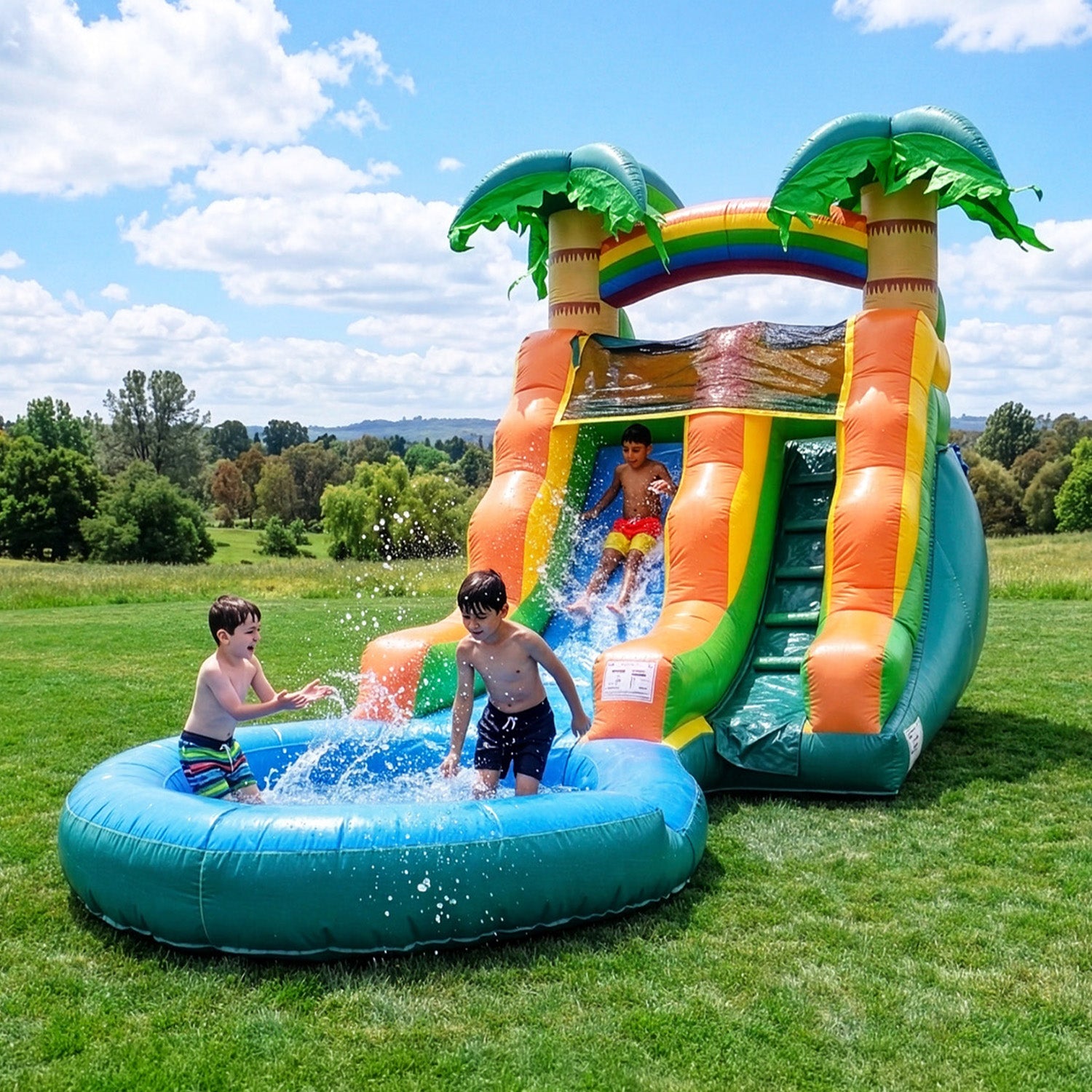
13' Summer Breeze Water Slide with Pool
Commercial vinyl at a big-box price — the entry point that is not a compromise
 In Stock
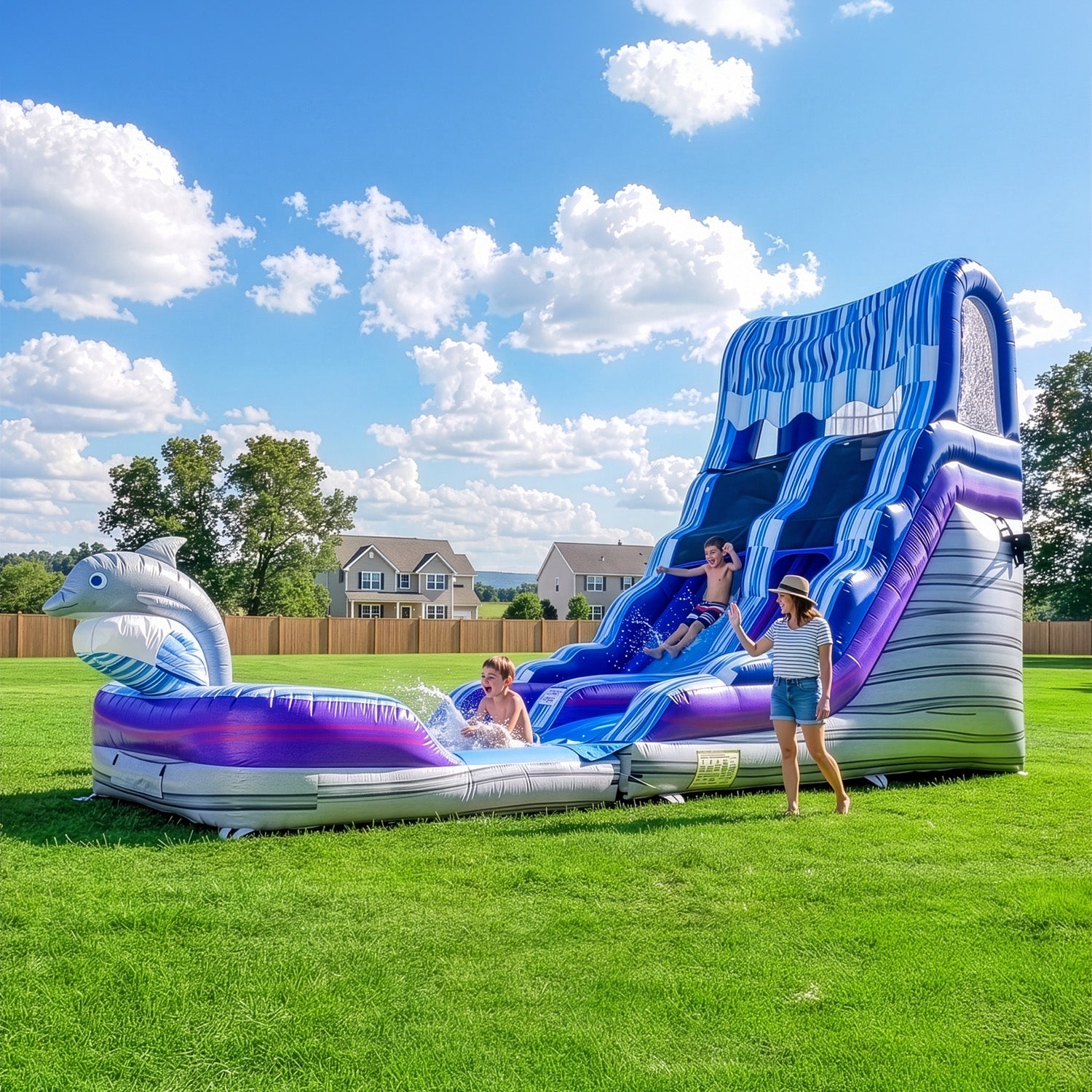
Dolphin 16' Water Slide with Detachable Pool
Half off MSRP, sixteen feet, and a pool that unclips for dry season
 In Stock
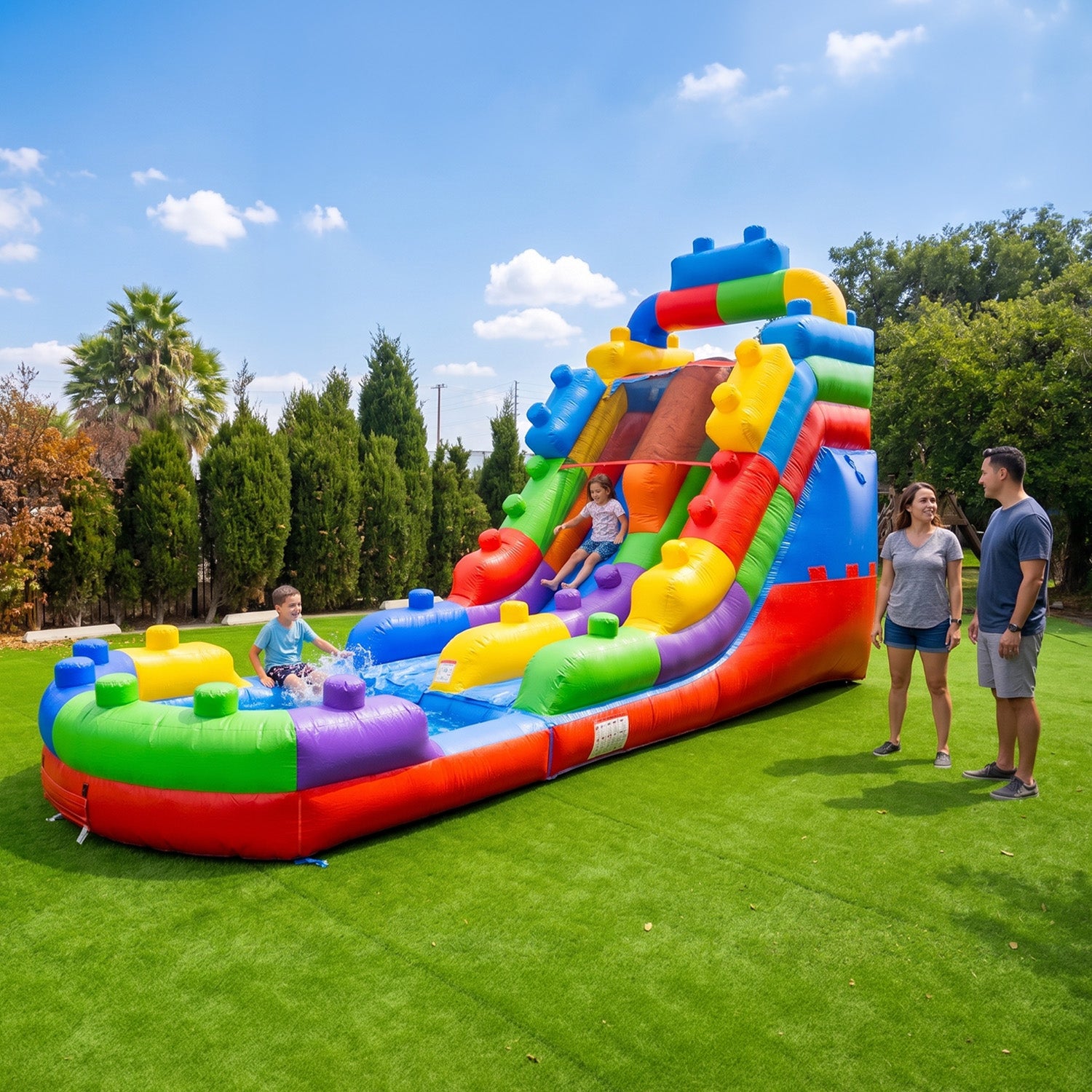
Block Party 16' Water Slide and Pool
Primary colors, block-party energy, and the shortest setup in the range
About the author
The WaterSlides4Kids Team
We sell commercial-grade inflatable water slides, which means we spend a lot of time answering the same questions about vinyl weight, blower sizing, yard measurements, and what actually breaks first. These guides are those answers, written down.
More about usKeep reading
More Guides
- Do You Need a Permit for an Inflatable Water Slide? US State-by-State OverviewWhere permits typically apply, how private backyard use usually differs from commercial operation, and how to check your own jurisdiction properly.
- How to Clean, Dry, and Store an Inflatable Water Slide So It Lasts 10 YearsTwenty minutes of drying is the difference between three seasons and ten. The full end-of-day routine, plus mildew rescue and off-season storage.
- Attached Pool vs. Detachable Pool Water Slides: Pros, Cons, and CleanupOne gives you two products from one purchase. The other removes the joint that fails first. How to choose, and what each means for setup and cleanup.