

Care & Maintenance
How to Clean, Dry, and Store an Inflatable Water Slide
Twenty minutes of drying is the difference between three seasons and ten. The full end-of-day routine, plus mildew rescue and off-season storage.
By The WaterSlides4Kids Team · · Updated · 9 min read
The single biggest factor in how long an inflatable water slide lasts is not the price you paid, the vinyl weight, or how gently the children treat it.
It is whether you dry it properly before it goes in the bag.
Damp storage is the leading cause of premature failure on inflatables — well ahead of punctures, seam wear and UV damage combined. It is also the one that is entirely within your control, costs nothing but twenty minutes, and voids most warranties when you get it wrong.
This is the routine.
Why damp storage destroys vinyl
Roll a wet slide into a bag and you have created an ideal environment for mildew: warm, dark, humid, no airflow, and an organic film of grass, sunscreen and skin cells to feed on.
Within days, mildew colonies establish on the PVC coating. They do not sit politely on the surface. Mildew produces acids that etch the coating, and etching does three things: it stains permanently, it creates microscopic surface roughness that holds more moisture and accelerates the next round, and it weakens the coating's bond to the base cloth underneath.
Once the coating starts separating from the cloth, the material has lost the thing that made it durable. That is not repairable, and it is why almost every manufacturer excludes mildew damage from warranty coverage — it is a maintenance failure, not a defect.
The smell arrives before the visible damage, and it is a genuinely stubborn one. If a slide smells musty, the process has already started.
The end-of-day routine
Twenty to thirty minutes, most of which is waiting.
1. Get everyone off and turn the water off first. Leave the blower running — everything that follows happens with the slide inflated.
2. Pull the drain plug. Site the unit with the plug corner downhill and the basin empties itself while you get on with the rest.
3. Rinse while inflated. Hose down the lane, the climbing wall, the platform and the basin. You are removing grass, dirt, sand and sunscreen residue. Inflated is much easier than flat — every surface is accessible and water runs off rather than pooling.
4. Wash if it needs it. Mild soap and a soft-bristle brush. Pay attention to the lane surface and the basin, which collect the most. Rinse thoroughly so no soap film is left behind.
Never use: bleach, solvent-based cleaners, degreasers, or a pressure washer. All four strip or damage the PVC coating, and all four void most warranties. Bleach in particular is the classic mistake — it does kill mildew, and it destroys the coating while doing so.
5. Squeegee the standing water. Push the water off the lane and out of the basin. Every gallon you remove mechanically is time you do not spend waiting for evaporation.
6. Dry it inflated, in moving air. This is the step people skip. Leave the blower running for at least twenty minutes with the unit standing. Sun helps; a breeze helps more. The blower is pushing air through the internal chambers the entire time, which dries the inside as well as the outside.
7. Check the folds. Before shutting down, run your hand into every crease, seam channel and corner — around the basin lip, at the base of the climbing wall, wherever two surfaces meet. These trap water and they are exactly where mildew starts. If anything is damp, keep going.
8. Deflate, fold, bag. Only once it is genuinely dry everywhere.
The rain problem
You will get caught out. Everyone does.
If the slide was still up when rain arrived, do not pack it away wet on the assumption that you will deal with it tomorrow. Tomorrow is often three days later, and three days is enough.
If you genuinely cannot dry it now, leave it loosely rolled and unbagged in a covered, ventilated space rather than sealed in the storage bag. A slide propped in a garage overnight is fine. A slide zipped into a bag overnight is where the problem starts.
Then re-inflate and dry it properly at the first opportunity.
Inspect while it is inflated
Drying time is free inspection time, and this is when everything is visible and accessible.
- Seams. Walk the whole unit looking for loose stitching or any sign of separation. Catch it early.
- Lane surface. The highest-wear area. Look for thinning or scuffing.
- Anchor points. Check the D-rings and their reinforcing patches.
- The detach seam, if you have a detachable pool. This is the joint that takes stress on every fit and removal.
- Sculpted appliqués, on themed units. Riders grab them on the climb, so the attachment seams see wear that flat panels do not.
- Small punctures. Listen for hissing and look for damp patches from the inside.
Patch punctures immediately. Every slide ships with a repair kit, and a small puncture patched on a clean, dry, deflated surface holds for years. The same puncture left alone becomes a tear the next time a rider goes over it.
Storage
Fold rather than stuff. Roll from the far end toward the blower connection, pushing air out as you go. Consistent folds mean less creasing, and creases are where the coating cracks over years.
Store indoors, off the floor. A garage shelf or a pallet. Concrete floors wick moisture upward, and a bag sitting directly on concrete through a winter will be damp by spring even if the slide went in dry.
Out of direct sunlight. UV degrades vinyl whether the slide is in use or in storage.
Somewhere with stable temperature if you can. Repeated freeze-thaw cycles are hard on PVC. An unheated garage is acceptable; an uninsulated shed in a cold climate is less kind.
Keep rodents out. Mice will nest in a stored inflatable, and they chew. A sealed plastic tote for the bagged slide solves it. Do not add mothballs — the chemicals attack vinyl.
Store the blower separately, dry, with the cord loosely coiled rather than tightly wound.
End-of-season deep clean
Once a year, before the slide goes away for the winter, do a longer version:
- Inflate somewhere clean.
- Full wash — mild soap, soft brush, every surface including the underside.
- Rinse completely.
- Dry inflated for a full hour, ideally in sun and moving air.
- Full inspection: every seam, every anchor point, the whole lane, the blower cord.
- Patch anything that needs patching and let repairs cure fully.
- Fold, bag, and store as above.
An hour once a year, and the unit comes out of storage in spring in the condition it went in.
If mildew has already started
Not necessarily fatal, if you catch it early.
- Inflate the unit outdoors.
- Scrub affected areas with a vinyl-safe cleaner and a soft brush. Some people have success with a very dilute white vinegar solution; test on a hidden area first. Not bleach.
- Rinse extremely thoroughly.
- Dry completely in sun and moving air — UV helps here.
- Repeat if needed.
Surface growth caught quickly usually cleans up. Deep staining where the coating has already been etched is permanent — the mark stays, and the material in that area is weaker than it was. Prevention is the only real fix.
Does this vary by slide?
Not much, but a few notes.
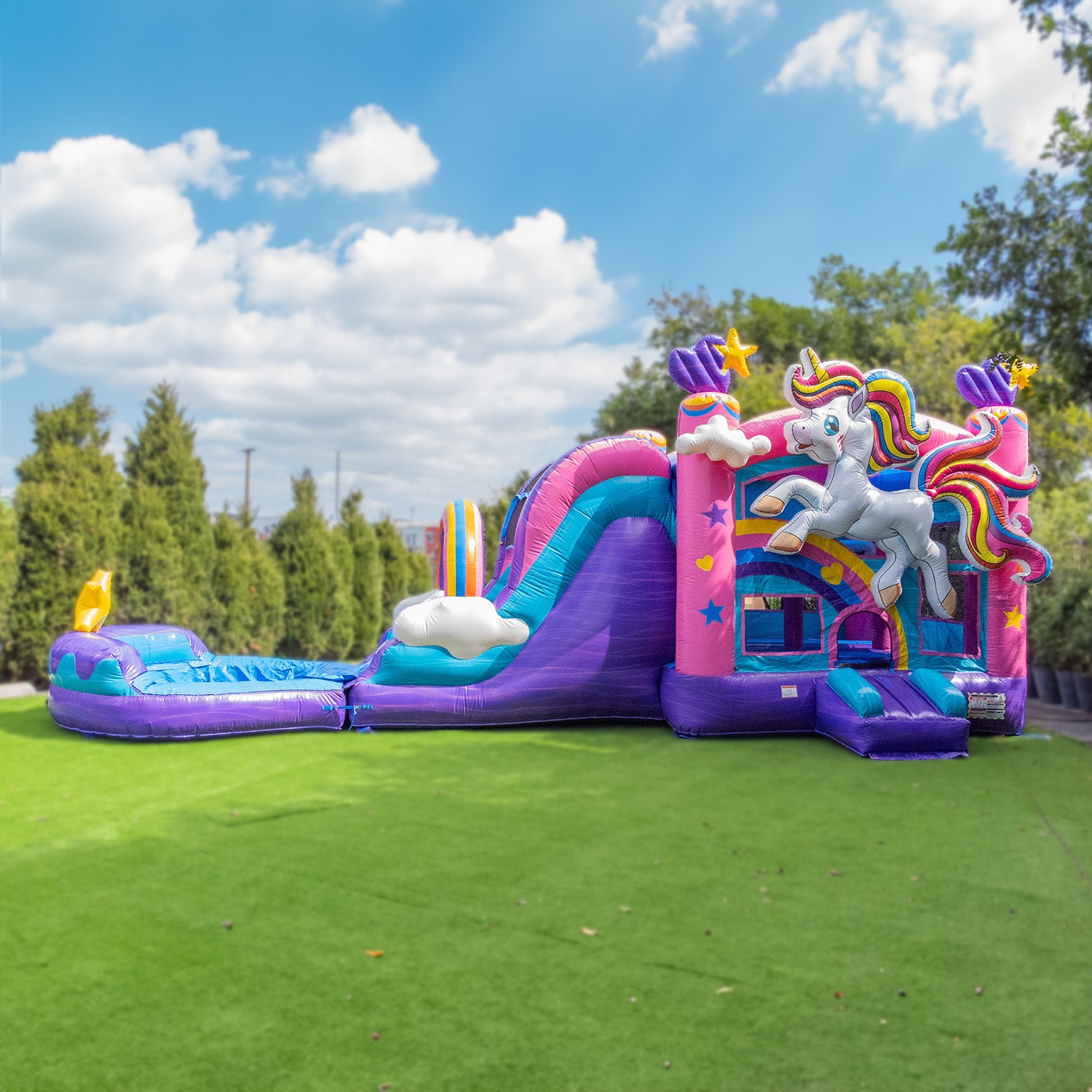
Pale colourways show it first. Light vinyl — the pastels on a unicorn combo, the yellows on a primary-colour unit — shows both dirt and early mildew staining sooner than dark vinyl. That is cosmetic warning, which is arguably useful. Darker units like the 17' Jungle Falls hide staining better, which means the damage is further along before you notice it. Do not let a forgiving colour make you complacent.
Deeply saturated colours still fade. The 16' Purple Tropical holds up well against staining, but all outdoor vinyl fades under UV over years. Storing it out of direct sun between uses is the thing you control.
Combos have more to check. More chambers, more seams, more folds holding water. Budget longer drying time.
Detachable pools dry faster separated. Two smaller pieces in moving air beat one large one.
Rental operators
Back-to-back weekend bookings create enormous pressure to roll a damp unit into the van and deal with it later. This is how rental fleets destroy their own inventory inside two seasons.
You need a covered space where a unit can be inflated to dry, and you need that drying time built into the schedule rather than hoped for. It is a real constraint on how many bookings you can take in a weekend, and operators who ignore it end up replacing vinyl rather than banking margin. We cover it alongside the rest of the operational load in the rental business guide.
The one-line version
Dry it completely, inflated, in moving air, before it goes in the bag. Every single time.
Twenty minutes per session is the difference between three seasons and ten. Nothing else you do to an inflatable water slide comes close to that return.
If you are still choosing a unit, the buyer's guide covers height, lanes and pool type, and commercial vs. residential vinyl explains what 15oz PVC buys you — a higher ceiling, which this routine is what lets you actually reach. Browse all 26 slides when you are ready.
Quick answers
Frequently asked
How do you clean an inflatable water slide?
Rinse it while it is still inflated, wash with mild soap and a soft brush, rinse again, then dry it completely before it goes in the bag. Avoid bleach and solvent cleaners — they degrade the PVC coating.
What happens if you store an inflatable water slide wet?
Mildew, which etches the coating, stains permanently, smells, and voids most warranties. It is the single most common cause of premature failure.
How do you get mildew off an inflatable slide?
Re-inflate, scrub affected areas with a mild vinyl-safe cleaner and a soft brush, rinse thoroughly and dry completely in sun and moving air. Deep staining may be permanent — prevention is the only real fix.
Mentioned in this guide
Slides Worth a Look
- Out of Stock
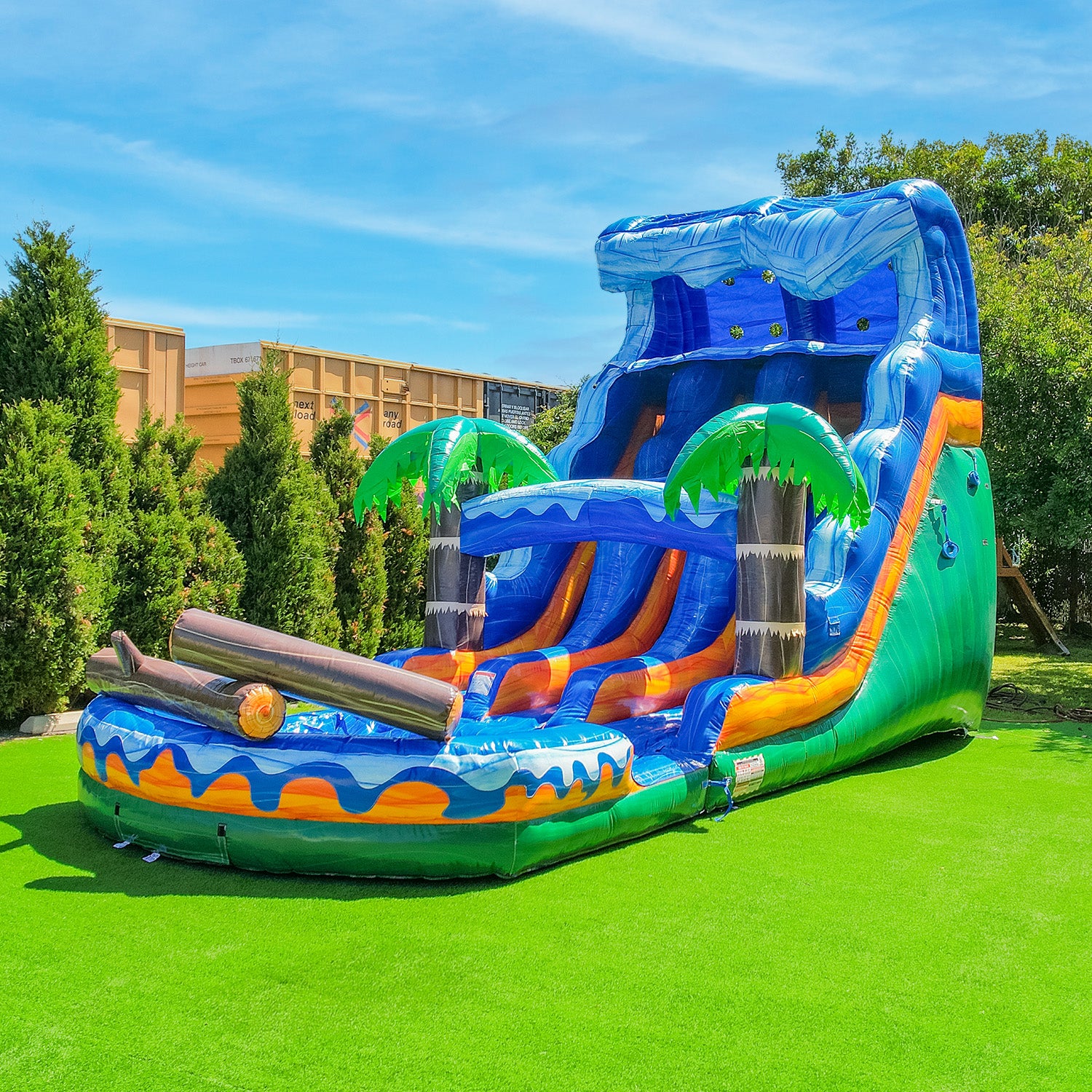
Jungle Falls 17' Dual Lane Water Slide with Detachable Pool
Waterfall theming on a seventeen-foot dual-lane frame
Call for Availability
View details 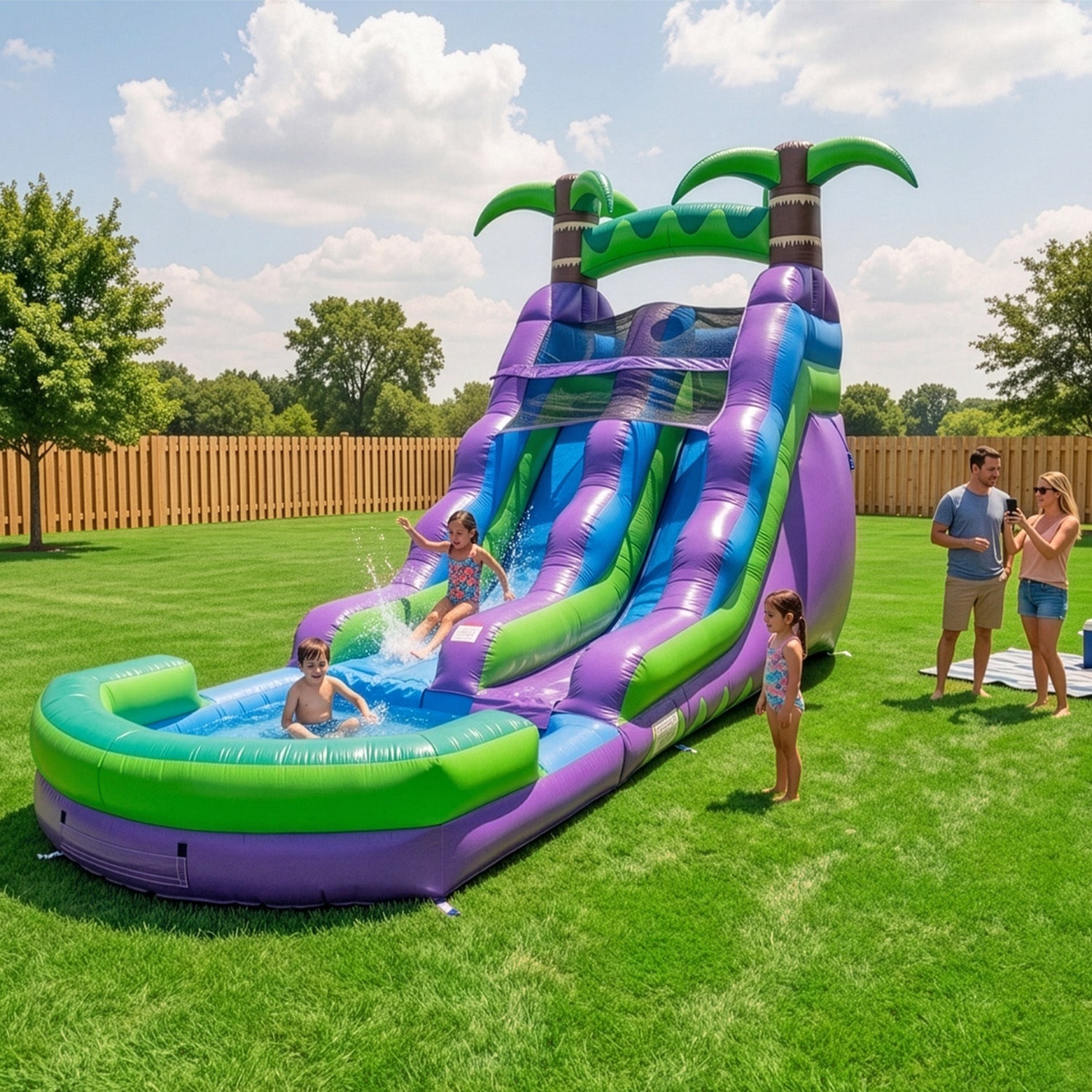 In Stock
16' Purple Tropical Water Slide with Attached Pool
The one that photographs best — purple, teal, and impossible to ignore
 Out of Stock
Unicorn Wet & Dry Bounce House with Slide and Detachable Deep Pool
The most-requested theme in party rental, on a three-configuration frame
Call for Availability
View details
About the author
The WaterSlides4Kids Team
We sell commercial-grade inflatable water slides, which means we spend a lot of time answering the same questions about vinyl weight, blower sizing, yard measurements, and what actually breaks first. These guides are those answers, written down.
More about usKeep reading
More Guides
- Do You Need a Permit for an Inflatable Water Slide? US State-by-State OverviewWhere permits typically apply, how private backyard use usually differs from commercial operation, and how to check your own jurisdiction properly.
- Attached Pool vs. Detachable Pool Water Slides: Pros, Cons, and CleanupOne gives you two products from one purchase. The other removes the joint that fails first. How to choose, and what each means for setup and cleanup.
- Inflatable Water Slide Safety: The Complete Setup & Supervision ChecklistSite selection, anchoring, wind limits, rider rules and supervision ratios — the checklist to run before anyone climbs, and the conditions that mean shutting down.