Setup & Safety
Do You Need a Permit for an Inflatable Water Slide?
Where permits typically apply, how private backyard use usually differs from commercial operation, and how to check your own jurisdiction properly.
By The WaterSlides4Kids Team · · Updated · 10 min read
Read this first. This article explains how inflatable amusement regulation is generally structured in the United States and how to find the rules that apply to you. It is not legal advice, and it does not state the requirements for any particular state or city — because those requirements vary considerably, change over time, and are frequently set at the municipal level rather than the state one. Always verify with your own local building, permitting or amusement-ride authority before operating.
The honest answer to "do I need a permit for an inflatable water slide?" is that it depends almost entirely on two things: whether you are using it privately or commercially, and where you are.
That is unsatisfying, so here is how to turn it into a specific answer for your situation.
The distinction that drives everything
Nearly every regulatory framework in this area draws a line between:
Private, non-commercial use. A slide you own, set up on property you own or occupy, for your own family and invited guests, with no charge for access.
Commercial or public operation. A slide rented out to others, operated at a public event, set up on public or institutional property, or used in a context where the public has access — whether or not money changes hands at the gate.
These two are typically treated very differently. Private backyard use is frequently outside the scope of amusement-device regulation entirely; commercial operation frequently is not. But "frequently" is not "always", which is why the verification step below matters.
Who actually regulates this
There is no single federal permit for operating an inflatable water slide in the United States. Regulation is distributed:
- The U.S. Consumer Product Safety Commission (cpsc.gov) has jurisdiction over consumer products, including recalls and safety alerts on inflatables. It is worth checking for notices, but the CPSC does not issue operating permits.
- States are the main source of amusement-device regulation. Many states have an amusement ride safety programme — typically administered by a department of labour, agriculture, insurance, or a dedicated board. Some states regulate inflatables specifically; some fold them into general amusement device rules; some do very little.
- Cities and counties frequently add their own requirements — special event permits, park use permits, temporary structure rules, or noise and setup restrictions. Municipal rules catch a lot of operators out because they look up the state rule and stop there.
- ASTM International maintains voluntary consensus standards for amusement rides and devices through its amusement ride committee. These are standards rather than law, but a number of states adopt them by reference, which turns a voluntary standard into a legal requirement in those places.
How to find your actual requirements
Twenty minutes of research, in this order.
1. Search for your state's amusement ride programme. Try "[your state] amusement ride safety" site:.gov and "[your state] inflatable amusement device regulations". The state directory at usa.gov/state-government will get you to the right agency listing if the search does not.
2. Call the agency and ask directly. This is faster and more reliable than reading. Ask specifically:
- Are inflatable amusement devices covered by your programme?
- Does the answer change for private residential use versus commercial rental?
- Is registration or an operating permit required, and for whom — the owner, the operator, or the event host?
- Is inspection required, and at what interval?
- Is proof of liability insurance required, and at what coverage limits?
- Do you adopt ASTM standards by reference?
3. Then call your city or county. Ask about special event permits, temporary structure permits, park use rules, and whether anything changes if the event is on private property but open to the public.
4. Ask the venue. Schools, churches, parks, community centres and corporate sites usually know their own requirements very well, because they have hosted this before. They will also tell you what documentation they need from you.
5. Ask your insurer. Insurers who write inflatable amusement policies know the regulatory landscape in the states they operate in, and it is in their interest that you are compliant.
For homeowners: what usually matters more than permits
If you are setting a slide up in your own backyard for your own children, permits are frequently not the operative constraint. These three usually are:
Your HOA. Covenants routinely restrict temporary structures, noise, and how long something can remain erected. A blower running for four hours is louder than people expect. Check the covenants and, if it is ambiguous, ask before rather than after.
Your homeowner's insurance. This is the one worth a phone call. Ask your carrier directly whether an inflatable water slide on your property is covered under your existing liability, and whether anything changes if neighbours' children are using it. Policies differ, and "attractive nuisance" considerations can apply. A five-minute call is cheap.
Utilities and easements. Overhead power lines are an absolute exclusion — do not site an inflatable anywhere near one. Underground utilities matter too, because you are driving stakes into the ground. In much of the US you can call 811 before digging, and stakes count.
Units in the 15–16 ft bracket are generally the easiest to site on residential property, simply because they need less overhead clearance than the flagships.
For rental operators: assume more, not less
If you rent units out, work on the assumption that more applies to you rather than less, and verify from there.
Typical requirements where they exist include business registration, amusement device registration for each unit, periodic inspection, operator training records, and general liability insurance written specifically for inflatable amusement rental — usually with the ability to name venues as additional insured.
Who carries the compliance burden — you or the customer — varies by jurisdiction and by contract. For commercial bookings it is usually the operator, but confirm it in writing for each event rather than assuming. A school booking and a backyard birthday can genuinely have different answers.
Neutral, high-utilisation units like the 16' Block Party or a wet/dry combo tend to be the ones going to the institutional venues where documentation gets asked for, so have your paperwork ready before you take those bookings. There is more on the operational side in the rental business guide.
Larger units raise the stakes
The bigger the structure, the more likely it triggers something. A 45-foot obstacle course at a school field day is a different proposition from a 13-foot slide in a backyard, in every respect — footprint, power, crowd size and regulatory attention.
For anything at that scale, involve the venue early. They will usually tell you exactly what they need, because they have been through it before.
Water adds a dimension
Some jurisdictions treat wet inflatables differently from dry ones, and there can be adjacent rules that have nothing to do with amusement devices: water use and drainage restrictions during a drought, stormwater rules about where several hundred gallons ends up, or health-department interest in standing water at public events.
If you are operating a wet unit publicly, ask about this specifically rather than assuming the amusement-device answer covers it.
What to do regardless of what the rules say
Compliance is a floor, not a ceiling. Whatever your jurisdiction requires or does not:
- Anchor every point, every time. Stakes on grass, ballast on hard surfaces.
- Know your unit's wind limit and deflate early, before conditions turn rather than during.
- Supervise continuously — one adult minimum, two on a combo with separate zones.
- Observe the stated weight limits, capacity and age range in your unit's documentation.
- Carry appropriate insurance even where nobody is checking.
Our safety and setup checklist covers all of this in practical detail. The overwhelming majority of serious incidents involve wind or inadequate anchoring, and neither is regulated into safety — they are prevented by the person setting the unit up.
The summary
There is no national permit. Whether you need one depends on your state, your municipality, your venue, and above all on whether the use is private or commercial. Private backyard use is often outside the scope of amusement-device rules; commercial operation often is not.
Do not take that as a determination for your situation. Call your state amusement ride programme and your local permitting office, ask the specific questions listed above, and get the answer in writing where you can. It takes an afternoon and it is the cheapest risk management available to you.
Once you know where you stand, browse our commercial-grade range — or start with the buyer's guide if you have not settled on a size.
Quick answers
Frequently asked
Do I need a permit for an inflatable water slide in my backyard?
Private, non-commercial use on your own property is generally treated differently from public or commercial operation, but rules vary by state and municipality and can be affected by HOA covenants. Check with your local building or permitting office.
Do commercial inflatable rentals need inspection?
Many states regulate inflatable amusement devices used commercially, and requirements can include registration, inspection and insurance. This is state-specific — verify with your state agency rather than relying on a general guide.
Who is responsible for getting a permit, the renter or the operator?
It varies by jurisdiction and by contract. For commercial bookings the operator usually carries the compliance burden, but confirm it in writing for each event.
Mentioned in this guide
Slides Worth a Look
- In Stock
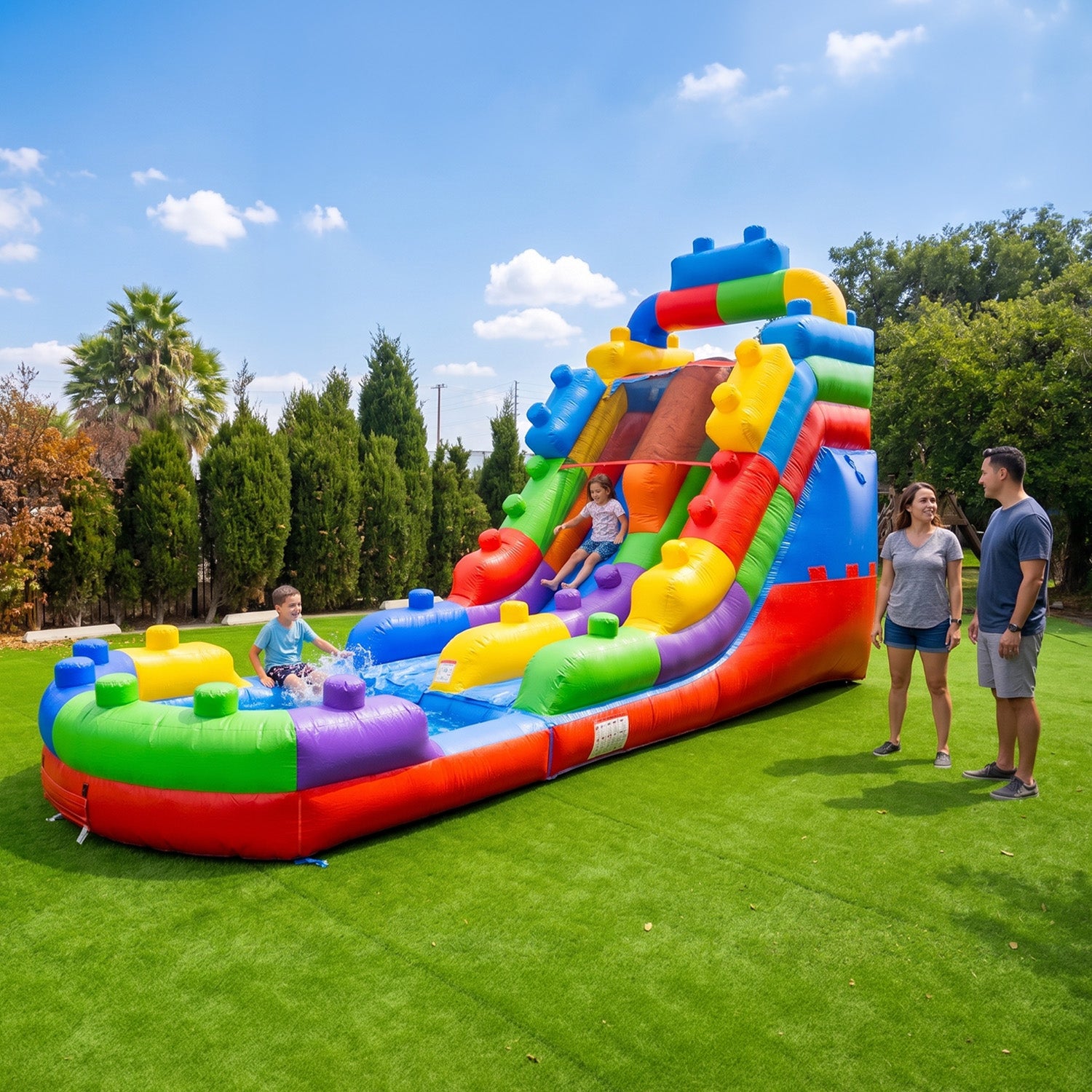
Block Party 16' Water Slide and Pool
Primary colors, block-party energy, and the shortest setup in the range
NEW! 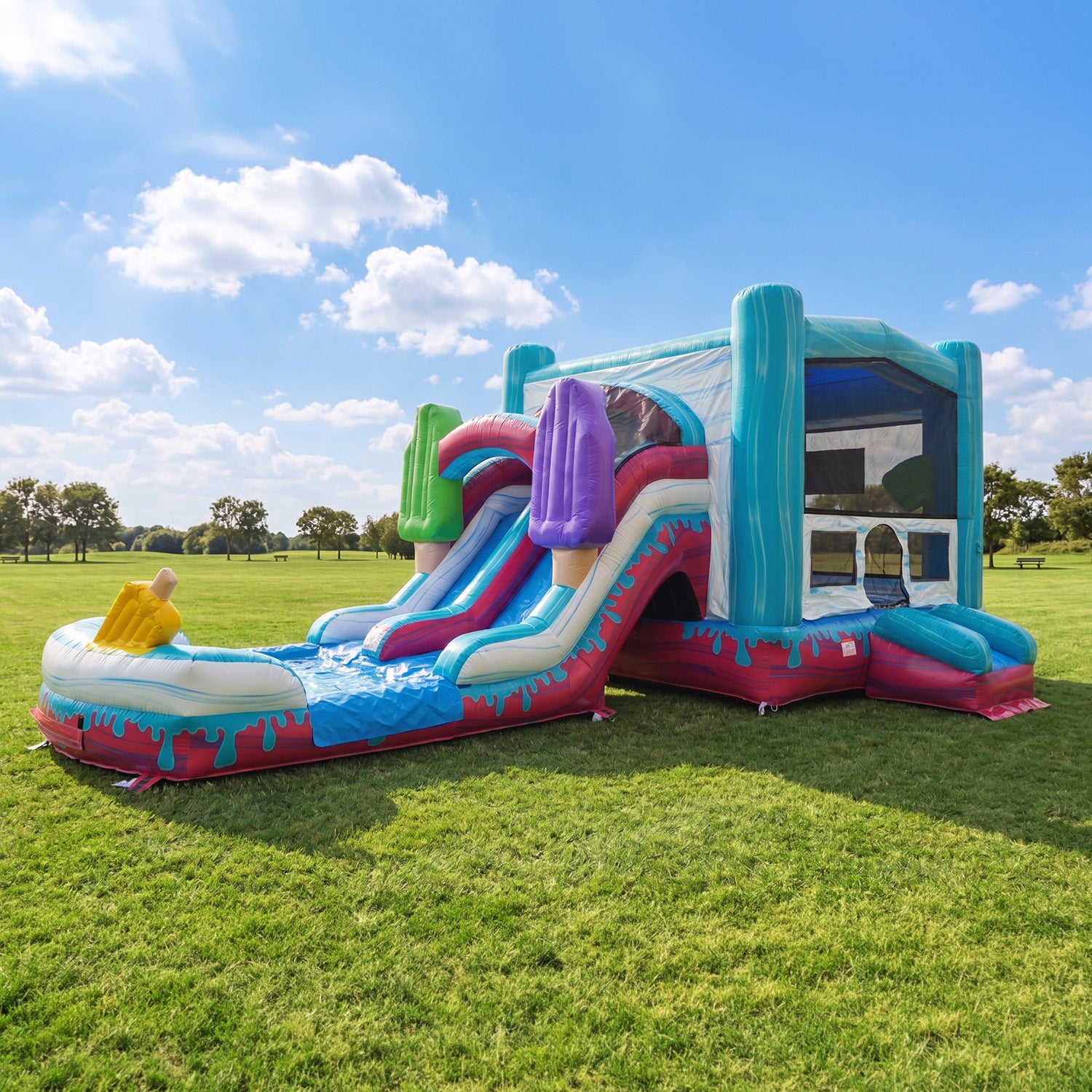 In Stock
Pop Splash Dual Lane Bounce House Combo with Slide & Attached Pool
Bounce house, climbing wall, two slide lanes, and a pool — in one unit
 Out of Stock
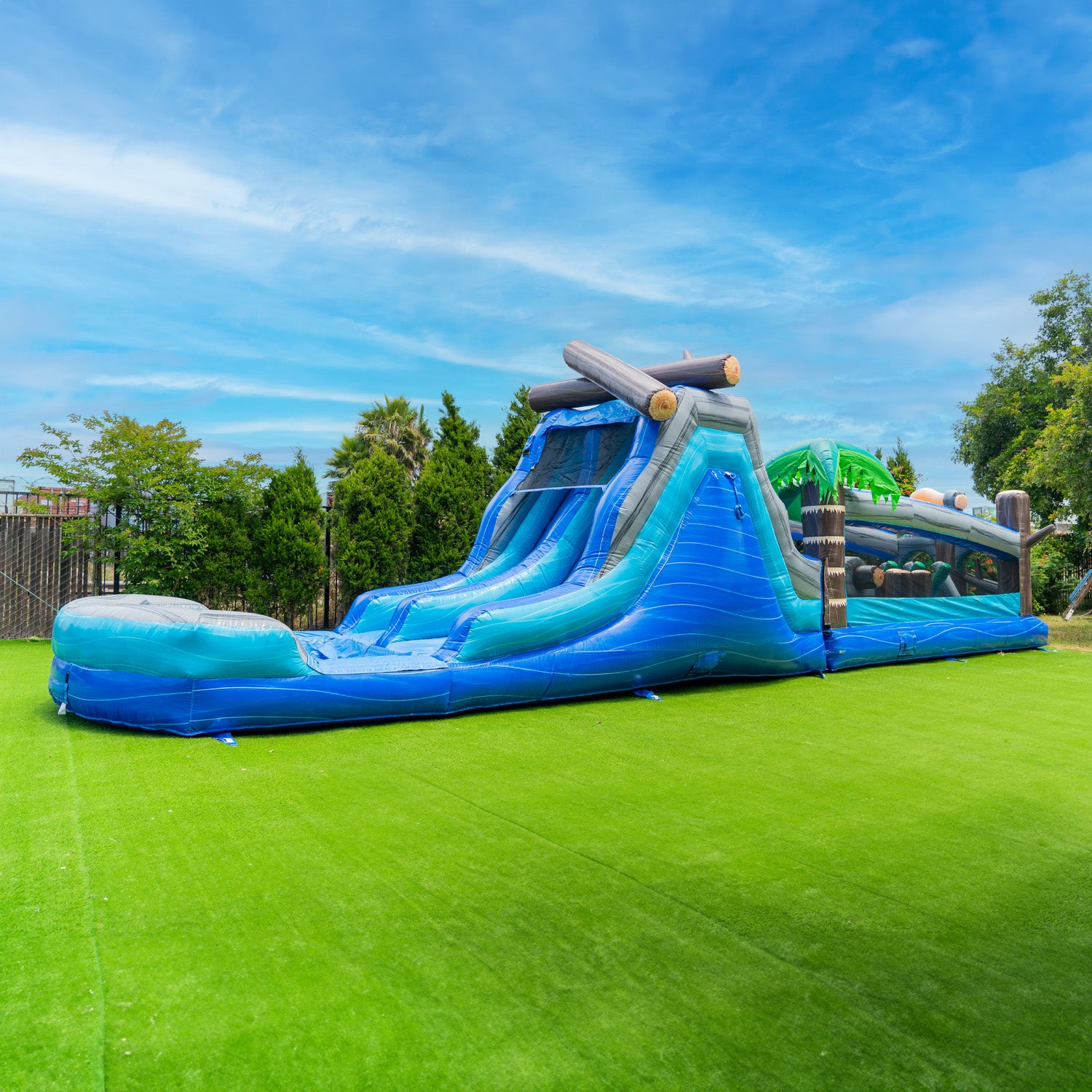
45' Tropical Wet/Dry Obstacle Course with Dual Lane Slide & Deep Pool
Forty-five feet of obstacles ending in a dual-lane slide and a deep pool
Call for Availability
View details
About the author
The WaterSlides4Kids Team
We sell commercial-grade inflatable water slides, which means we spend a lot of time answering the same questions about vinyl weight, blower sizing, yard measurements, and what actually breaks first. These guides are those answers, written down.
More about usKeep reading
More Guides
- How to Clean, Dry, and Store an Inflatable Water Slide So It Lasts 10 YearsTwenty minutes of drying is the difference between three seasons and ten. The full end-of-day routine, plus mildew rescue and off-season storage.
- Attached Pool vs. Detachable Pool Water Slides: Pros, Cons, and CleanupOne gives you two products from one purchase. The other removes the joint that fails first. How to choose, and what each means for setup and cleanup.
- Inflatable Water Slide Safety: The Complete Setup & Supervision ChecklistSite selection, anchoring, wind limits, rider rules and supervision ratios — the checklist to run before anyone climbs, and the conditions that mean shutting down.