

Business
How to Start a Water Slide Rental Business
Startup costs, realistic booking rates, the payback calculation, and the operational details — insurance, transport, staffing — that decide whether this works.
By The WaterSlides4Kids Team · · Updated · 12 min read
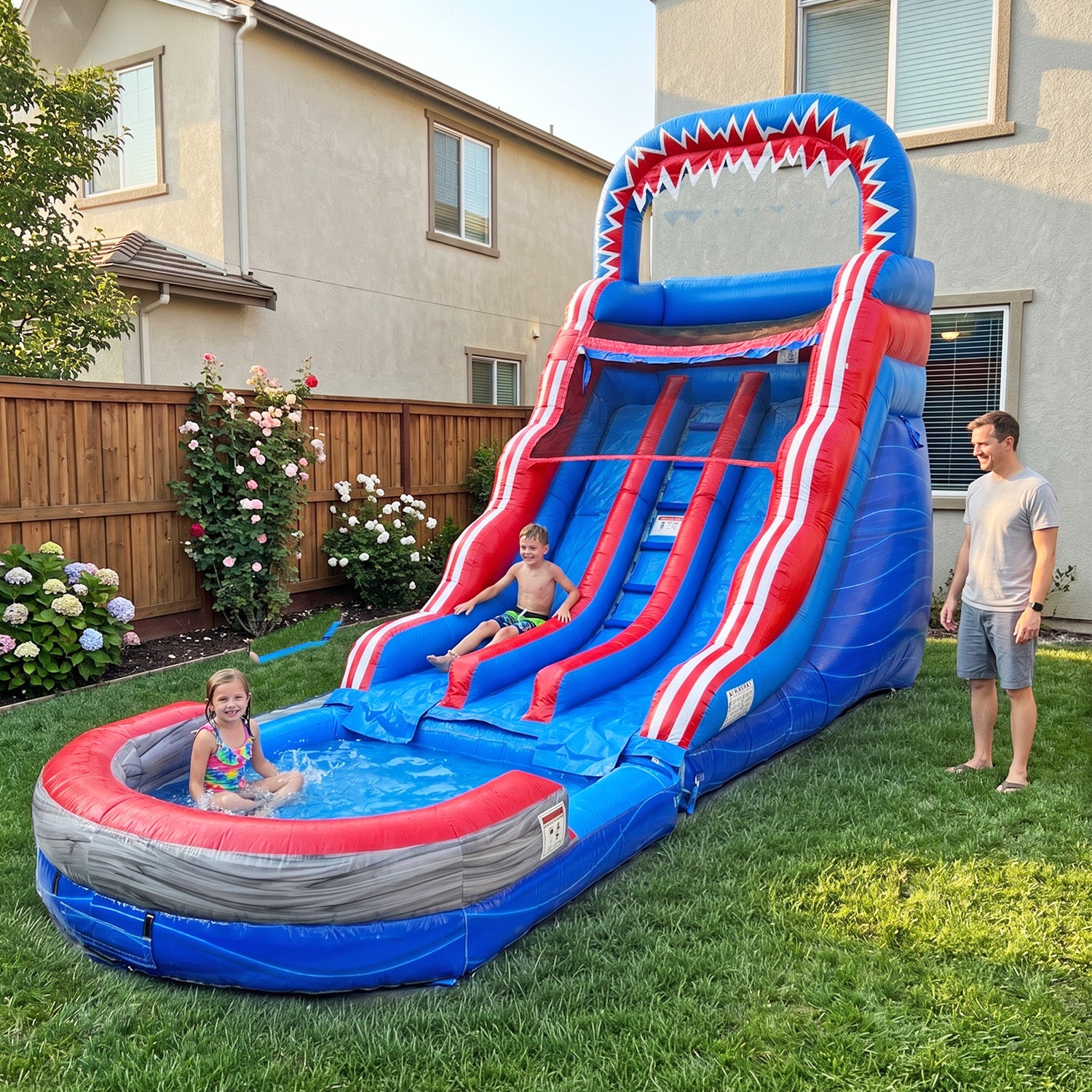
A water slide rental business is one of the few side businesses where the unit economics are genuinely good and the barrier to entry is genuinely low. It is also one where a lot of people lose money in year one, almost always for the same three reasons.
This guide covers the maths honestly — including the costs that never appear in the enthusiastic versions of this article — and what to buy first.
The headline number, and the asterisk
A commercial dual-lane water slide rents for somewhere between $200 and $400 per day in most US markets. A unit like the 17' Rocket Rush costs about $1,800.
At $250 a booking, that is seven or eight bookings to cover the purchase price. In a busy market with a decent summer, that is achievable inside the first season — and in a strong one, inside two months.
The asterisk is that the purchase price is not your only cost, the season is short, and bookings do not arrive because you own a slide. Let us do this properly.
Realistic startup costs
| Item | Typical cost | Notes | | --- | --- | --- | | First unit | $1,800 – $2,900 | Dual lane, commercial grade | | Liability insurance | Varies widely | Get quotes before you buy. See below. | | Vehicle capability | $0 – significant | Must carry 300–700 lb and a bulky load | | Hand truck / dolly | $100 – $250 | Your back will thank you | | Ground tarps | $60 – $150 | Two, so one can dry while the other works | | Extension cords, 12-gauge | $80 – $160 | Heavy gauge. Thin cords starve blowers. | | Extra stakes and sandbags | $100 – $200 | For hard-surface setups | | Cleaning supplies | $50 | Mild soap, soft brushes, squeegee | | Booking system / website | $0 – $500/yr | A form and a calendar is enough to start | | Business registration | Varies by state | Check your Secretary of State |
The two lines with no number attached are the two that decide whether this works: insurance and your vehicle.
Insurance — sort this before you buy anything
General liability cover written specifically for inflatable amusement rental is the standard requirement in this industry. A generic small-business policy usually will not respond to an inflatable claim, and finding that out after an incident is the worst possible time.
Most venues — schools, churches, parks, HOAs, corporate sites — will require a certificate of insurance and will ask to be named as additional insured on it. If you cannot produce one, you cannot take those bookings, and those bookings are where the good money is.
Costs vary enormously by state, by coverage limits, and by whether you are operating wet units. Get quotes before you buy a slide, not after. Talk to a broker who writes policies for this industry specifically — they exist, and they will ask you questions a generic broker will not think to ask. If the premium makes the business unviable in your state, that is genuinely useful information to have before you have spent thousands on inventory.
Permits, inspections and registration
Many states regulate inflatable amusement devices used commercially, and requirements can include registration, periodic inspection, operator training and proof of insurance. Some states regulate heavily; some barely at all.
This is genuinely state-specific and it changes. Verify with your own state agency — usually the department of labour, agriculture, or whichever body handles amusement ride safety — rather than relying on a general article, including this one. Our permit overview explains where to look and what questions to ask, but it is a starting point for your research, not a substitute for it.
What to buy first
The instinct is to buy the biggest, most impressive unit you can afford. That is usually wrong.
Buy a 17-foot dual-lane unit with a detachable pool. Here is the reasoning:
- Dual lane handles the throughput at large events, which is where the margin is. A single-lane unit at a school fun day produces a queue that becomes the organiser's problem — and next year, someone else's booking.
- Seventeen feet is the practical peak of the size-versus-placeability curve. It generates enough speed to satisfy the hardest group to impress (eight- to thirteen-year-olds), it clears the tree line at most sites, and it fits on a standard trailer and through a standard gate. Nineteen-foot units frequently do not — and a unit you cannot get into a customer's backyard is a refunded booking and a wasted Saturday.
- A detachable pool turns one unit into two listings. Wet in summer, dry for indoor and shoulder-season events. Same storage footprint, same truck load, roughly double the bookable calendar.
The 17' Surf Beach fits that description exactly, with a detachable deep pool. The Rocket Rush is the lower-cost route to the same configuration.
Buy a neutral theme first. This one costs people real money. A unicorn books unicorn parties. A dinosaur books dinosaur parties. A tropical or primary-colour unit books birthdays, corporate family days, school fairs, church picnics and block parties — everything. Character themes are excellent as your second and third units, once you have coverage; as your only unit they narrow your bookable calendar for no gain.
Unit two and three
Once the first unit is booking consistently:
Add a combo. A wet/dry bounce house combo lists as a premium item precisely because it replaces two rentals — customers pay more and you deliver one item to one address. Combos also run dry indoors in winter, which is when a slide-only fleet is earning nothing.
Then add character themes. Unicorn and dinosaur are the two most-requested concepts and they rarely overlap in the same booking, so carrying both covers most themed enquiries.
Then consider a flagship. A 19-foot dual-lane unit is a marketing asset as much as a revenue line — it is what appears on your booking page and next year's flyer. It is also a demanding purchase: bigger vehicle, longer setup, two blower circuits, more staff. Most operators are better off adding it in year two.
The three reasons year one goes wrong
1. Underestimating the operational load. Every booking is: load, drive, set up, wait or return, collect, clean, dry, store. A single booking consumes a chunk of a day even though the slide is only up for four hours. Two bookings on the same Saturday at opposite ends of a city is a genuinely hard day. Price your time in from the start.
2. Not drying units properly between bookings. This is the one that destroys inventory. Back-to-back weekend bookings create enormous pressure to roll a damp slide into the van and deal with it later. Do that repeatedly and you will be buying replacement vinyl inside two seasons — mildew etches the PVC coating and voids most warranties. You need a covered space where a unit can be inflated and dried properly, and you need to build that time into your schedule rather than hoping for it. The cleaning and storage guide has the routine.
3. Pricing on the competition instead of on cost. New operators routinely undercut established ones to win early bookings, then discover their margin does not cover insurance, fuel, replacement and their own time. Work out your true cost per booking — including a sinking fund for eventual replacement — and price above it.
Seasonality, and what to do about it
In most of the US you have roughly a fourteen-to-eighteen-week wet season. That is the entire year's revenue for a water-only fleet, and it is why the detachable pool matters so much: dry configurations extend you into school events in autumn and spring, and indoor birthdays through winter.
Plan your cash flow around a short earning window and a long dry one. A repayment schedule that assumes even monthly income will squeeze you in February — worth raising explicitly with any lender, as covered on our financing page.
Where bookings actually come from
In rough order of effectiveness for a new operator:
- A Google Business Profile. Free, and "bounce house rental near me" is how most people search. Fill it in completely and add real photographs of your own units.
- Photographs. Bookings follow pictures. Photograph your unit set up, in sunlight, with the water running — not the manufacturer's stock image. This is why bright, high-contrast units out-book muted ones.
- Repeat and referral. Parents talk. One well-run party generates several enquiries, which is why being on time and set up before guests arrive matters more than any advertising.
- Schools, churches and community groups. Higher value, booked further ahead, and they will ask for your certificate of insurance.
- Local Facebook groups. Where parents plan parties. Be useful rather than promotional.
A conservative first-year model
Assume you buy one $1,800 dual-lane unit and price at $250 per booking.
- Realistic first season for a new operator with no reputation: 12–20 bookings.
- Revenue at 15 bookings: $3,750.
- Less insurance, fuel, consumables and replacement fund: call it 35% of revenue.
- Contribution: roughly $2,400 against an $1,800 unit.
So: the slide pays for itself in season one, and you finish slightly ahead having built a customer list, a photograph library and a review history. Year two, with the same unit and an established profile, is where it becomes properly profitable.
That is a realistic outcome. Anyone promising you $20,000 in a first summer is selling something.
The short checklist
- Get insurance quotes before buying inventory.
- Check your state's registration and inspection requirements directly.
- Buy one 17-foot dual-lane unit with a detachable pool, in a neutral theme.
- Confirm your vehicle can carry 300–700 lb and the bulk.
- Secure covered space where a unit can be inflated to dry.
- Set up a Google Business Profile and photograph your own unit.
- Price on your real costs, not on undercutting the incumbent.
- Add a combo as unit two, character themes as three and four.
Browse commercial-grade slides, or talk to us before a multi-unit order — there are combinations that work considerably better as a fleet than as individual purchases. If you have not settled on configuration yet, the dual lane comparison and the buyer's guide are the places to start.
Quick answers
Frequently asked
Is a water slide rental business profitable?
It can be, and the margin per booking is high because the main cost is the unit itself. Profitability depends on booking volume in a short season, insurance costs, and whether you can transport and set up efficiently.
How much does it cost to start a water slide rental business?
The unit is the largest line item. Beyond that, budget for liability insurance, a vehicle that can carry 300–500 lb, anchoring and cleaning equipment, and a booking system.
What insurance do I need to rent out inflatable water slides?
General liability cover written for inflatable amusement rental is the standard requirement, and most venues will ask to be named as additional insured. Speak to a broker who knows this industry — do not rely on a generic small-business policy.
Mentioned in this guide
Slides Worth a Look
NEW! In StockRocket Rush 17' Dual Lane Water Slide with Detachable Pool
Dual lane, detachable pool, 17 feet — the most slide per dollar we sell
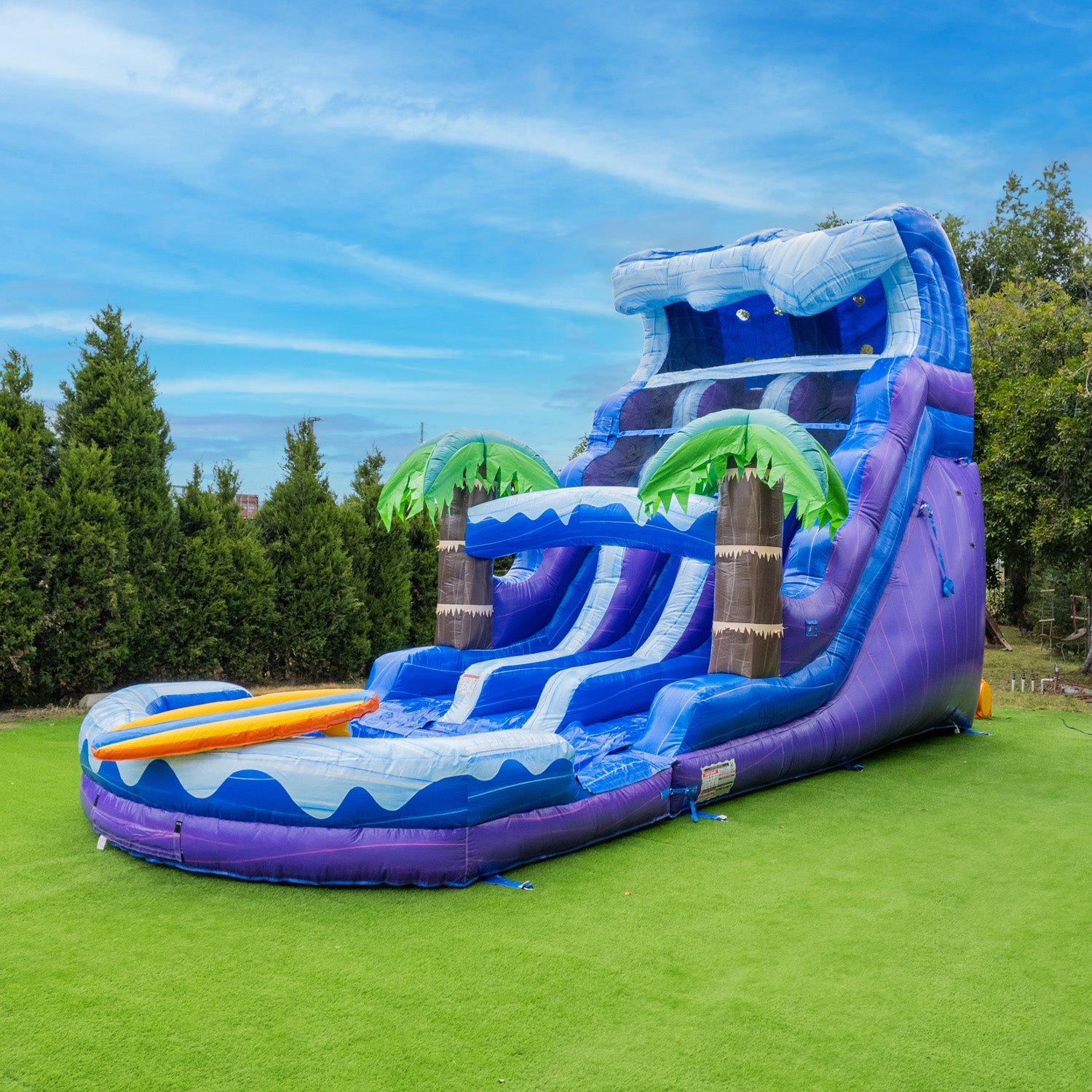 In Stock
Surf Beach 17' Dual Lane Water Slide with Detachable Deep Pool
Dual lane, deep pool, and it all comes apart for dry season
NEW! 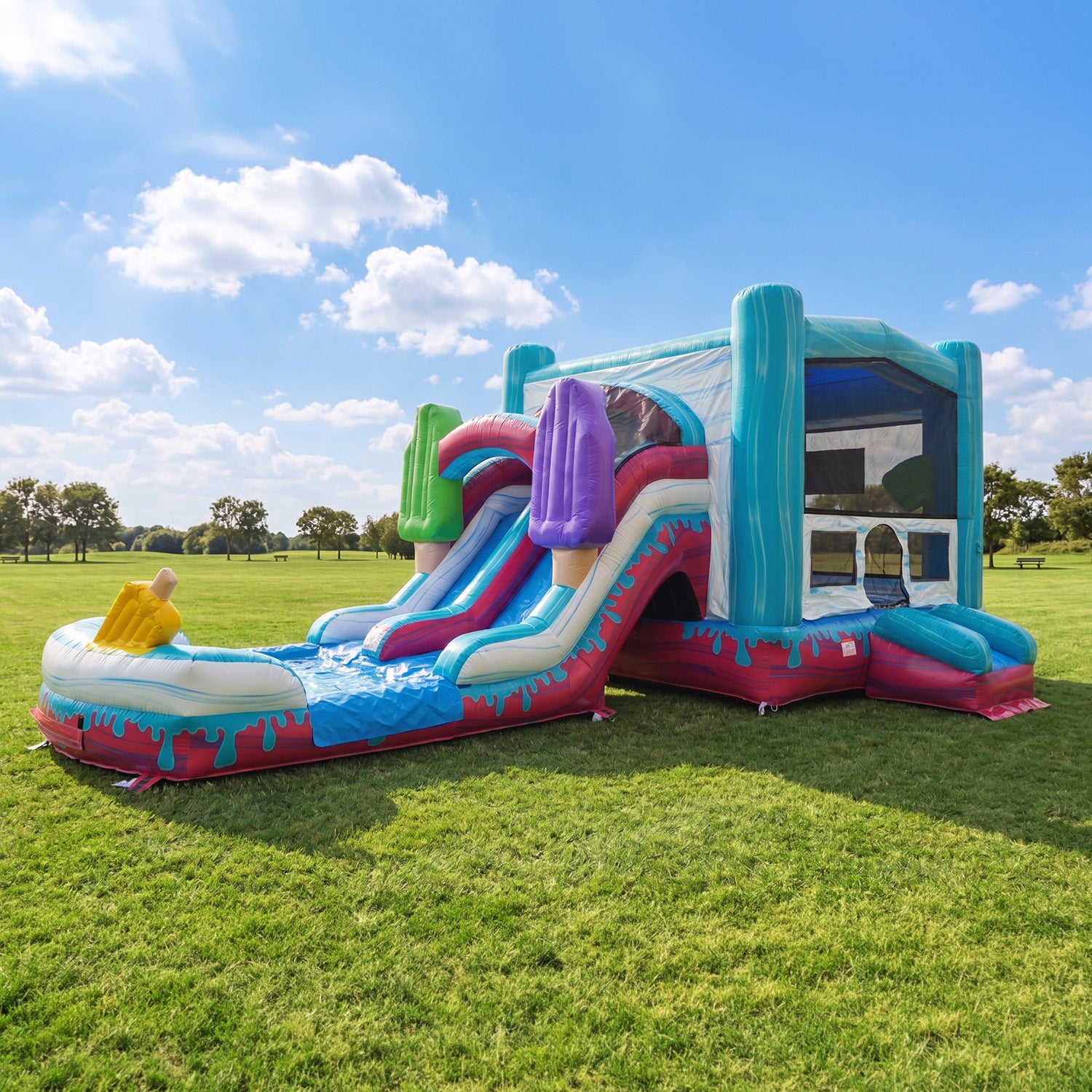 In Stock
Pop Splash Dual Lane Bounce House Combo with Slide & Attached Pool
Bounce house, climbing wall, two slide lanes, and a pool — in one unit
About the author
The WaterSlides4Kids Team
We sell commercial-grade inflatable water slides, which means we spend a lot of time answering the same questions about vinyl weight, blower sizing, yard measurements, and what actually breaks first. These guides are those answers, written down.
More about usKeep reading
More Guides
- Do You Need a Permit for an Inflatable Water Slide? US State-by-State OverviewWhere permits typically apply, how private backyard use usually differs from commercial operation, and how to check your own jurisdiction properly.
- How to Clean, Dry, and Store an Inflatable Water Slide So It Lasts 10 YearsTwenty minutes of drying is the difference between three seasons and ten. The full end-of-day routine, plus mildew rescue and off-season storage.
- Attached Pool vs. Detachable Pool Water Slides: Pros, Cons, and CleanupOne gives you two products from one purchase. The other removes the joint that fails first. How to choose, and what each means for setup and cleanup.