

Buying Guides
How to Choose the Best Inflatable Water Slide for Your Backyard
Four decisions determine whether you buy the right slide: height, lane count, pool type, and vinyl weight. Everything else is decoration. Here is how to get each one right.
By The WaterSlides4Kids Team · · Updated · 9 min read
Buying an inflatable water slide feels like it should be a simple decision and turns into a bad one surprisingly often. The photographs all look similar, the listings quote specifications in different orders, and the price range runs from under a thousand dollars to nearly four thousand for products that appear, at a glance, to do the same thing.
They do not do the same thing. And the differences that matter are not the ones the marketing leads with.
There are exactly four decisions that determine whether you end up with a slide your family uses every weekend for a decade or an expensive lesson. Get these right and the theme, the colour and the character on the climbing wall are matters of taste. Get them wrong and no amount of good branding rescues the purchase.
Decision 1: Height — and the mistake nearly everyone makes
The most common error in this category is buying taller than the household will actually use, and it happens for an understandable reason. A nineteen-foot slide is genuinely impressive. It photographs well. It feels like the grown-up choice.
It is also a long climb.
For a five- or six-year-old, the ascent is work rather than part of the fun. Parents report the same pattern with striking consistency: the tall slide gets ridden four or five times on the first afternoon and then quietly abandoned, while a shorter slide runs continuously until someone calls the kids in for dinner. Capability and enthusiasm are different variables. A six-year-old is physically capable of climbing a seventeen-foot wall. They will not want to do it thirty times.
Match the height to your youngest regular rider, unless the oldest is genuinely the only one who matters.
| Height | Best for | Typical footprint | Notes | | --- | --- | --- | --- | | 12–13 ft | Ages 3–9 | ~29' × 17' | Climbable without a boost. Fits narrow yards. | | 15–16 ft | Ages 5–12 | ~35' × 19' | The best-selling bracket and the widest choice. | | 17–18 ft | Ages 6–13 | ~42' × 24' | What rental fleets standardise on. Real speed. | | 19 ft + | Events | ~46' × 26' | Deep pools, two blower circuits, serious clearance. |
If your children are four to eight, something like the 13' Summer Breeze is very likely the correct purchase, and the money you did not spend buys several more summers of use. If they are already nine or ten, size up — they will outgrow a 13-footer within a season or two.
There is one genuine exception. A household with a wide age spread is often better served by a dual-lane slide at a lower height than a single-lane slide at a taller one, because the racing keeps older kids engaged at a height the youngest can still manage alone.
Decision 2: Lanes — throughput, or the social dynamic?
The obvious argument for two lanes is capacity. A single-lane slide cycles roughly one rider every eight to ten seconds once you account for the climb. Two lanes on the same climbing wall roughly halve the effective wait.
The less obvious argument is better. Two lanes turn a queue into a race. Kids pair up at the top and go together, and the entire experience changes — instead of standing in line they are organising heats, calling rematches, and arguing about who cheated. At a birthday party with fifteen guests that is the difference between forty minutes of entertainment and four hours.
It also solves the sibling problem. On a single lane, one child rides while the other waits, and the waiting is where the arguments start. On a dual lane they go together, every single time.
So when is a single lane right?
- Small groups. With a handful of kids, throughput is not your bottleneck. The second lane buys you a wider footprint and a higher price and nothing else.
- Young or nervous riders. A single lane is wider for the same overall footprint. There is room to go down sideways, off-centre, or clutching a parent's hand at the top. Wide and forgiving beats narrow and fast for a hesitant five-year-old.
- Narrow yards. Width is the dimension most backyards run out of first, and two lanes are two lanes at any height.
If you want racing without the height, the 13' Tropic Tide Double Racer puts two full lanes on a small frame — roughly the ground area of a single-lane 15-footer.
Decision 3: Pool type — one product or two?
An attached pool is a single inflated chamber continuous with the slide body. Nothing to align, nothing to assemble, and — importantly — no detach seam. That seam is the joint that gets stressed every time a pool is fitted and removed, and after a few dozen cycles it is the first place a hard-used slide starts to weep. Attached-pool units also set up fastest, typically in three to four minutes. Something like the 16' Ocean Wave goes from bag to standing before your first guest has parked.
A detachable pool buys you a second product. Take the pool off and the slide runs dry onto a landing mat, which opens up indoor events, fall festivals, and school days when nobody wants to be soaked. For a family that is two or three extra months of use each year. For a rental operator it is a second listing at no extra inventory cost.
The trade-off is one more assembly step, one more component to store, and one more seam to inspect each season. Neither option is better in the abstract — it depends entirely on whether dry operation is worth anything to you.
Decision 4: Vinyl weight — the only spec worth arguing about
This is the one that determines whether you buy a slide once or twice.
The market splits into two grades that are far less similar than their overlapping price tags suggest:
- Consumer grade: 6–9oz PVC, double-stitched seams, engineered for roughly twenty uses.
- Commercial grade: 15oz PVC, quadruple-stitched seams, reinforced stress points, built for repeated commercial cycling.
Fifteen ounces refers to the weight of one square yard of the coated fabric. Heavier means a thicker base cloth and a heavier PVC coating, which resists abrasion, punctures and UV dramatically better. It also feels different underfoot — commercial vinyl does not stretch and thin out under a heavy rider the way light material does.
The cost comparison only makes sense over time. A cheap slide replaced every second summer costs more across five years than a commercial unit bought once, and it fails at the least convenient possible moment: mid-party, at a seam, with a garden full of children waiting. We go through the full comparison in commercial vs. residential water slides.
Now check your site — and look up
Every product page lists a recommended clear footprint. Take that number, add walking room on all sides so you can stake the unit and supervise it, and confirm the ground is level. A slope you cannot see by eye will make one lane of a racer faster than the other and pool water at one end of the landing basin.
Then look up, from where the slide will actually stand rather than from the patio. Overhead clearance disqualifies more residential sites than lawn area does, and virtually nobody checks it before ordering. Mature tree canopy, gutters, floodlights and the overhead service drop from the street all occupy the airspace a slide needs. A unit that rubs a branch every time it shifts in the wind will wear through the vinyl long before the seams give out.
Finally, work out where the water goes. Several hundred gallons has to end up somewhere that is not your foundation or your neighbour's lawn. Site the slide so the drain plug faces downhill.
Power, and the mistake that ruins delivery day
These are constant-airflow inflatables. The blower runs for the entire session — there is no inflate-and-unplug mode — and every slide we sell ships with one sized for that unit.
The larger flagships and combos need two or more blowers, and those blowers need genuinely separate circuits, not two outlets on the same one. This is the single most common reason a big inflatable fails to stand up on delivery day, and it takes five minutes of planning to avoid. Our blower sizing guide explains why CFM matters more than the horsepower number on the box.
What actually determines lifespan
Not the price you paid. The drying routine.
Vinyl put away damp grows mildew that etches the coating, stains permanently, smells, and voids most warranties. It is the leading cause of premature failure by a wide margin — well ahead of punctures, seam wear or UV damage. Twenty minutes of drying before the slide goes into the bag is the difference between three seasons and ten, and it costs nothing but patience. The cleaning and storage guide has the full routine.
Anchoring is the other non-negotiable. Every unit ships with stakes and tether ropes, and they are the difference between an inflatable and a very large kite. On hard surfaces, ballast replaces stakes at every anchor point, plus a tarp underneath.
Putting it together
Work through the decisions in order and the shortlist assembles itself:
- Height — set by your youngest regular rider and your overhead clearance.
- Lanes — two if you have multiple kids or big parties, one if you do not.
- Pool — detachable if dry-season use is worth something, attached if setup speed and durability matter more.
- Vinyl — 15oz commercial, always. This one is not a trade-off.
For a lot of families that lands on a 15- or 16-foot single-lane slide with an attached pool, which is exactly why that bracket outsells everything else. For households with two or three kids close in age, a dual-lane racer like the 15' Tropical Breeze earns its money in arguments not had. For older kids who want genuine speed, the 17' Rocket Rush combines both lanes and a detachable pool.
Ready to narrow it down? Browse all 26 slides with filters for height, lanes, pool type and availability — or call us and describe your yard. We would genuinely rather point you at a smaller slide you will use than sell you a bigger one you will not.
Quick answers
Frequently asked
What is the best size inflatable water slide for a backyard?
For most suburban yards, 13ft to 16ft. Match the height to your youngest regular rider rather than your oldest — the most common buying mistake is going taller than the household will actually use.
How much should I spend on a good inflatable water slide?
Commercial-grade units start around $700 and run to about $3,700 for the largest dual-lane flagships. The number that matters is vinyl weight: 15oz commercial PVC lasts years, 6–9oz consumer vinyl lasts a season or two.
Are inflatable water slides worth it?
For a household that will use it several weekends a season for a few years, a commercial-grade slide costs less per use than repeatedly renting one. A cheap consumer slide replaced every second summer is the worst of both.
Mentioned in this guide
Slides Worth a Look
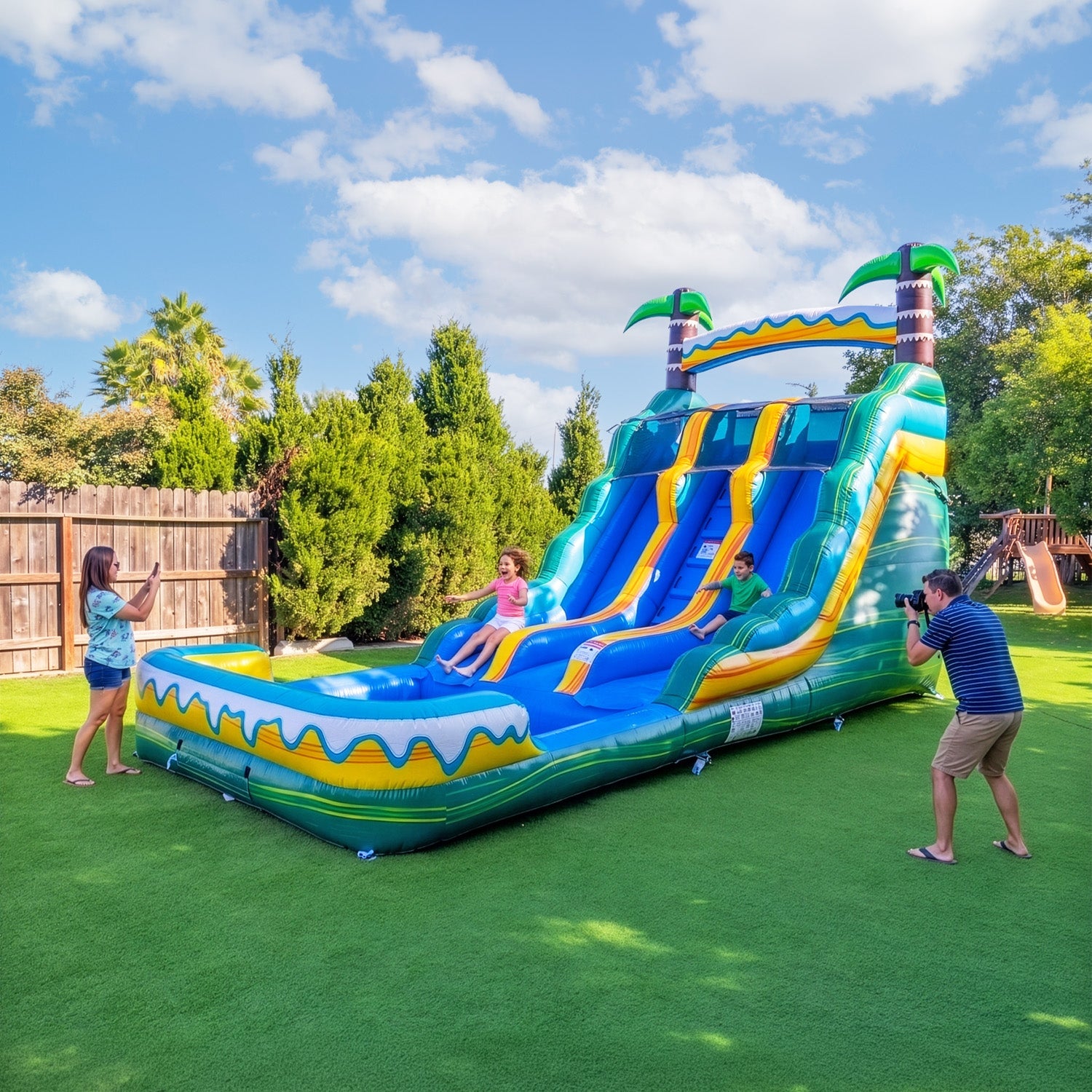
NEW! In StockTropical Breeze 15' Dual Lane Water Slide
Two lanes, one winner — the racing slide that ends every argument
 In StockBest Value
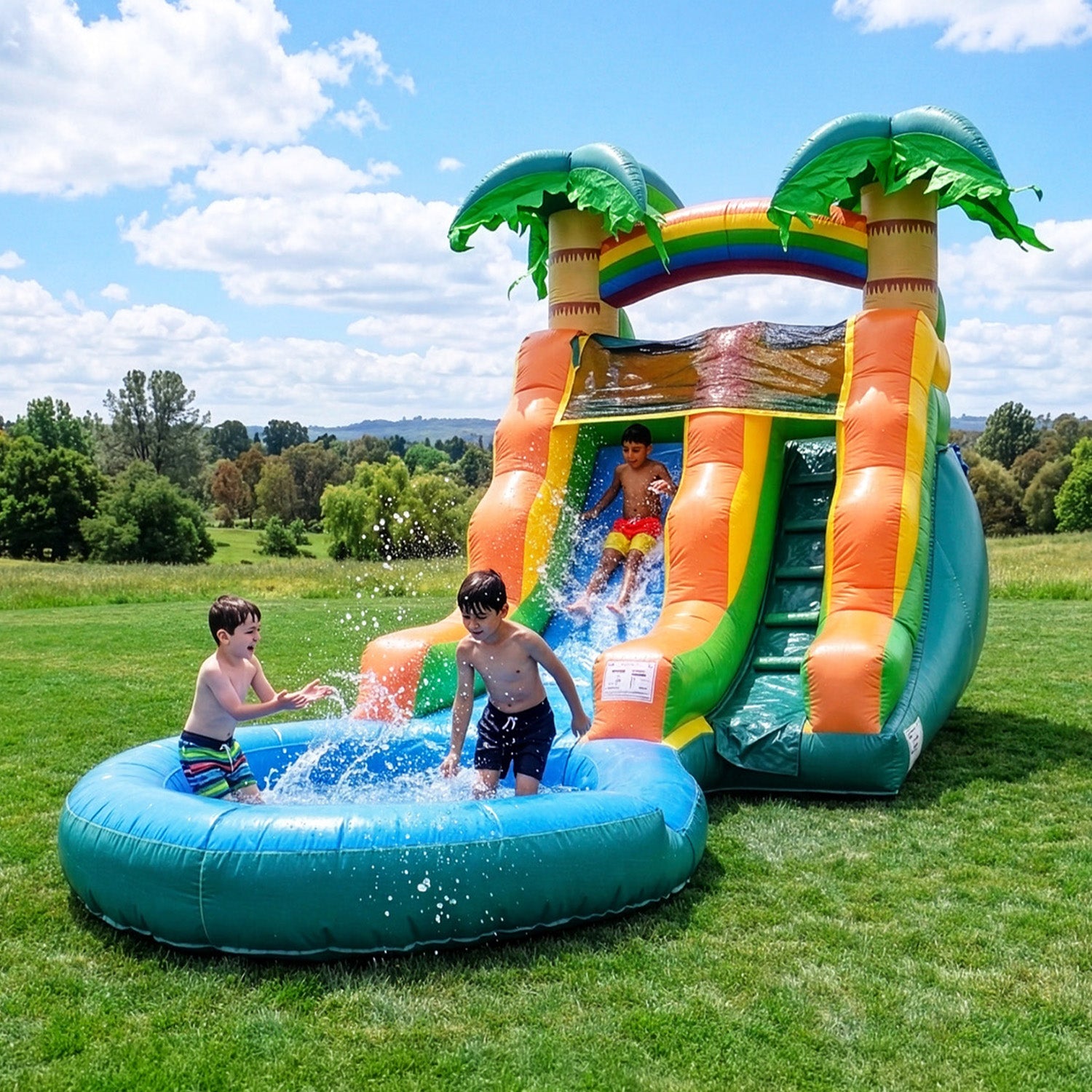
13' Summer Breeze Water Slide with Pool
Commercial vinyl at a big-box price — the entry point that is not a compromise
 In Stock
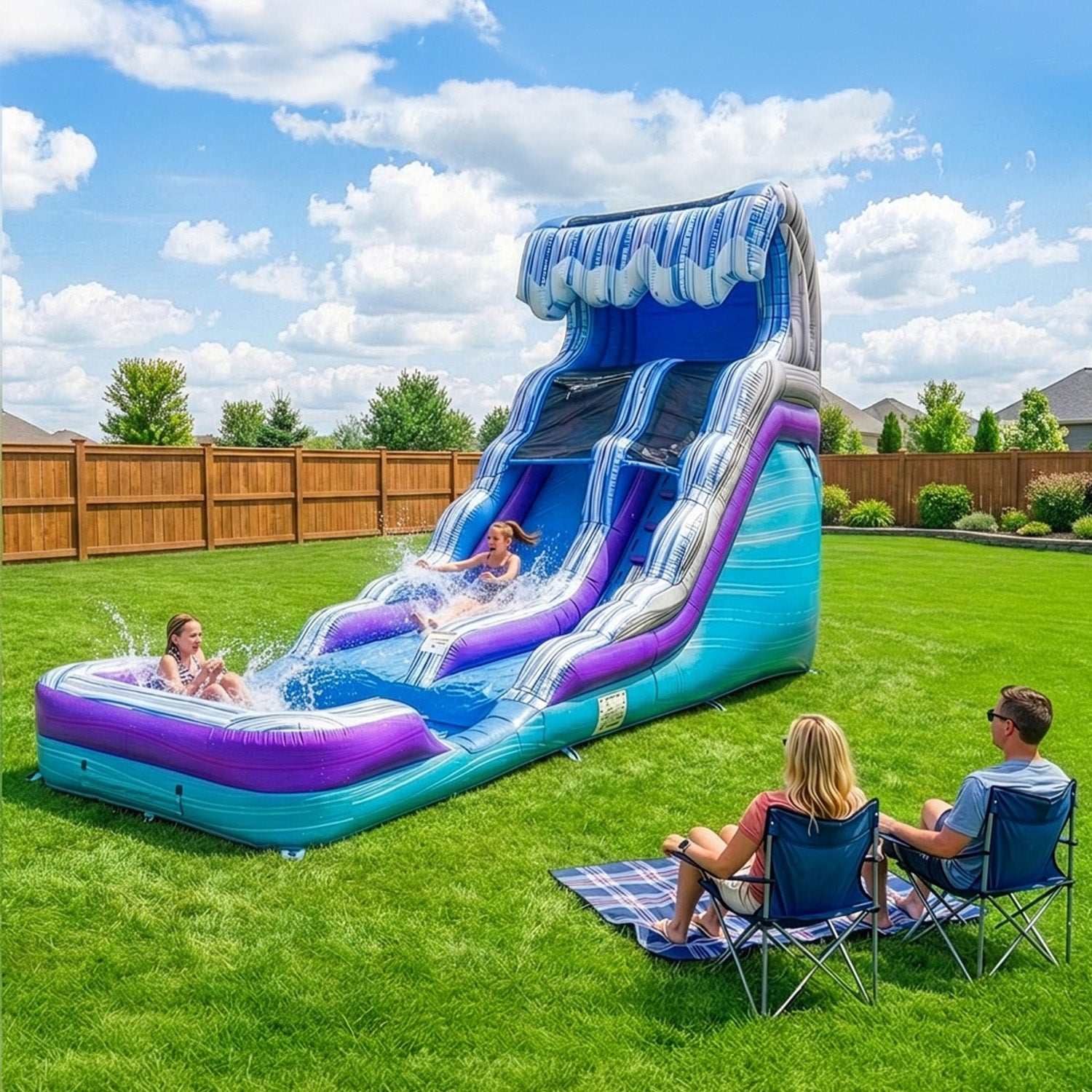
Ocean Wave 16' Water Slide with Attached Pool
One chamber, one blower, zero assembly — the simplest 16-footer we sell
About the author
The WaterSlides4Kids Team
We sell commercial-grade inflatable water slides, which means we spend a lot of time answering the same questions about vinyl weight, blower sizing, yard measurements, and what actually breaks first. These guides are those answers, written down.
More about usKeep reading
More Guides
- Do You Need a Permit for an Inflatable Water Slide? US State-by-State OverviewWhere permits typically apply, how private backyard use usually differs from commercial operation, and how to check your own jurisdiction properly.
- How to Clean, Dry, and Store an Inflatable Water Slide So It Lasts 10 YearsTwenty minutes of drying is the difference between three seasons and ten. The full end-of-day routine, plus mildew rescue and off-season storage.
- Attached Pool vs. Detachable Pool Water Slides: Pros, Cons, and CleanupOne gives you two products from one purchase. The other removes the joint that fails first. How to choose, and what each means for setup and cleanup.