

Buying Guides
Dual Lane vs. Single Lane Water Slides: Which Should You Buy?
A second lane does more than double capacity — it turns a queue into a race. But single lane is wider, cheaper and more forgiving. Here is where the crossover sits.
By The WaterSlides4Kids Team · · Updated · 8 min read
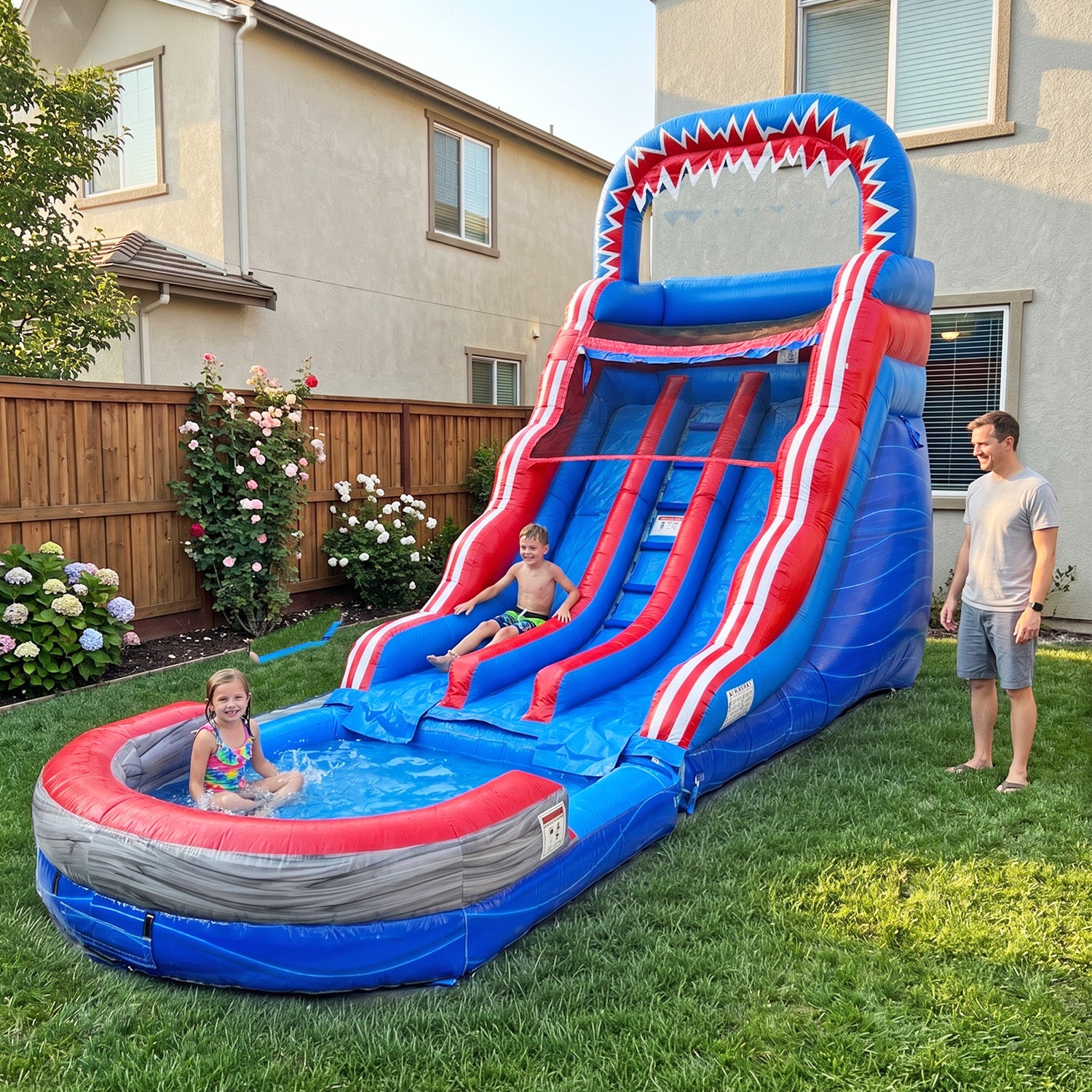
Ask someone who sells inflatable water slides which is better, one lane or two, and the honest answer is a question back: how many kids, and how old?
That sounds like a dodge. It is not. The two configurations solve genuinely different problems, and the more expensive one is frequently the wrong purchase.
What the second lane actually does
The standard pitch is throughput, and it is true as far as it goes. A single-lane slide cycles roughly one rider every eight to ten seconds once you account for the climb. Two lanes fed by one climbing wall roughly halve the effective wait.
But the arithmetic understates the effect, because the important change is behavioural.
Two lanes turn a queue into a race. With one lane, children stand in a line, and the line is where the boredom and the arguing live. With two, they pair up at the top and go together — and the moment they do, the ride becomes a contest. They organise heats. They call rematches. They dispute the start. A dual-lane slide is not twice as good as a single-lane slide; it is a different activity that happens to use the same equipment.
For a birthday party with fifteen guests, that is the difference between a slide exhausted in forty minutes and one that runs until parents start collecting their children.
The sibling problem
Anyone with two children under ten already knows the specific failure mode a second lane fixes.
On a single lane, one child rides and the other waits. The waiting produces the negotiation, the negotiation produces the disagreement, and the adult supervising becomes a referee for the afternoon. On a dual lane they go together every time. There is nothing to negotiate.
This is, in practice, the reason most families who buy a racer are glad they did — not the throughput number, the peace.
When a single lane is the better buy
A single lane is not the budget option. It is the correct option in several common situations.
It is wider. For the same total footprint, one lane is meaningfully broader than either half of a two-lane unit. That matters for riders who go down sideways, off-centre, on their stomachs, or clutching a parent's hand at the top. Wide and forgiving beats narrow and fast for a hesitant five-year-old.
It fits narrower yards. Width is the dimension most backyards run out of first, and two lanes are two lanes at any height. If your garden is long and narrow, a single-lane slide of the same height will fit where a racer will not.
It costs less at equal height. At the same build quality and drop, a single lane is cheaper — money that could buy you three more feet of height instead, which is often the better trade for a household with older kids.
It is simpler to supervise. One lane means one landing point to watch. On a busy party that genuinely reduces the mental load.
Something like the 16' Ocean Wave is a good example of the case: a wide single lane, an attached pool, four-minute setup, and a footprint that fits an ordinary quarter-acre lot.
Where the crossover sits
If you want a rule of thumb rather than a philosophy:
| Situation | Better choice | | --- | --- | | One child, or two far apart in age | Single lane, spend the difference on height | | Two or three children close in age | Dual lane | | Regular parties above ~8–10 kids | Dual lane | | Narrow yard, width-constrained | Single lane | | Young or nervous riders | Single lane (wider, more forgiving) | | Buying to rent | Dual lane, almost always |
The eight-to-ten simultaneous riders figure is where queueing stops being trivial and starts being the thing people remember about the party.
Lane dividers, and why one lane can feel faster
A detail worth knowing when you compare racers: the divider between the lanes should be a full-height inflated baffle, not a stitched-on ridge.
It matters most exactly where it is hardest to see. Riders reach their highest speed at the bottom of the lane, and a low divider lets two racers drift together at precisely that point. Every dual-lane slide we carry uses a full-height divider for that reason.
The other thing that comes up constantly: manufactured lanes are mirrored — identical slope, identical drop, identical surface — so a fair race genuinely comes down to the riders. When one lane consistently feels faster, the cause is almost always ground that is not level. Check with a spirit level rather than by eye. A slope you cannot see is a slope a nine-year-old will absolutely notice and complain about for the rest of the afternoon.
Racing without the height
There is a real gap in this market that is worth knowing about. Most dual-lane slides start at fifteen feet, which forces families with four- to eight-year-olds to choose between racing and a height their children will actually use unassisted.
A small number of units solve that. The 13' Tropic Tide Double Racer puts two full-width lanes on a thirteen-foot frame, in roughly the ground area of a single-lane fifteen-footer. The 12' Block Party Backload goes shorter still and moves the climbing wall to the rear, so climbers and riders never cross paths — which on a unit aimed at three-to-eight-year-olds is worth more than the extra foot of height it gives up.
For a household with two or three young children, one of these is very often the best purchase in the entire category.
Dual lane for rental operators
If you are buying to rent rather than to own, the calculation shifts hard toward two lanes.
Large events are where the money is, and large events need throughput. A single-lane unit at a school fun day produces a queue that becomes the organiser's problem — and next year, somebody else's booking. A racer handles the crowd and gets rebooked.
The most flexible inventory you can hold is a dual-lane unit with a detachable pool, because the same frame produces a summer water rental and a dry autumn and winter rental. One storage footprint, one truck load, two listings. The 17' Rocket Rush is the clearest example in our range — two lanes, detachable pool, and seventeen feet, which is the height most professional fleets standardise on because it clears the tree line at most sites and still fits on a single trailer.
We work through the payback numbers properly in the rental business guide.
Practical differences to plan for
A few things that only surface once the unit arrives.
Footprint. Budget more width for a racer — typically two to four feet more than a single-lane slide of the same height. Measure across, not just along.
Power. Dual-lane units at seventeen feet and above generally need two blowers on separate circuits. Not two outlets on one circuit, which is the most common cause of a large inflatable failing to stand up on delivery day. Our blower guide covers how to work that out beforehand.
Setup time. A racer takes a little longer, mostly because there is more vinyl to lay out straight. Figure five to eight minutes rather than three to four.
Supervision. Two lanes means two riders arriving at once. On a shallow splash basin that is fine. On a deep pool it means you need to be watching both, which is a real argument for a second adult at busy events.
Water. Two lanes need water down both. A single hose with a splitter handles it — you need a film of water on each lane, not a torrent.
The short version
Buy two lanes if you have multiple children close in age, if you regularly host groups above eight or ten, or if you are renting the unit out. The racing changes what the slide is, and it removes the waiting that causes most of the friction.
Buy one lane if you have a single child, a narrow yard, young or hesitant riders, or if you would rather put the money into three extra feet of height. A wide single lane is more forgiving, easier to supervise and cheaper at the same build quality.
Whichever you choose, the material spec should not change: 15oz commercial PVC with quadruple-stitched seams. That decision is covered in commercial vs. residential water slides, and the full sequence of decisions is in the buyer's guide.
Ready to compare? Browse every dual lane slide we carry, or see all 26 slides with filters for height, lanes and pool type.
Quick answers
Frequently asked
Is a dual lane water slide worth the extra money?
With two or more children close in age, or parties above roughly eight to ten kids, yes. For an only child or small gatherings, spend the difference on height instead.
Do dual lane water slides need more space?
More width, roughly the same length. Width is the dimension most backyards run out of first, so measure across before you decide.
Can two kids go down the same lane together?
No. Each rider needs the full runout to decelerate. Two riders in one lane removes that room, which is the point of having two lanes.
Mentioned in this guide
Slides Worth a Look
NEW! In StockRocket Rush 17' Dual Lane Water Slide with Detachable Pool
Dual lane, detachable pool, 17 feet — the most slide per dollar we sell
NEW! 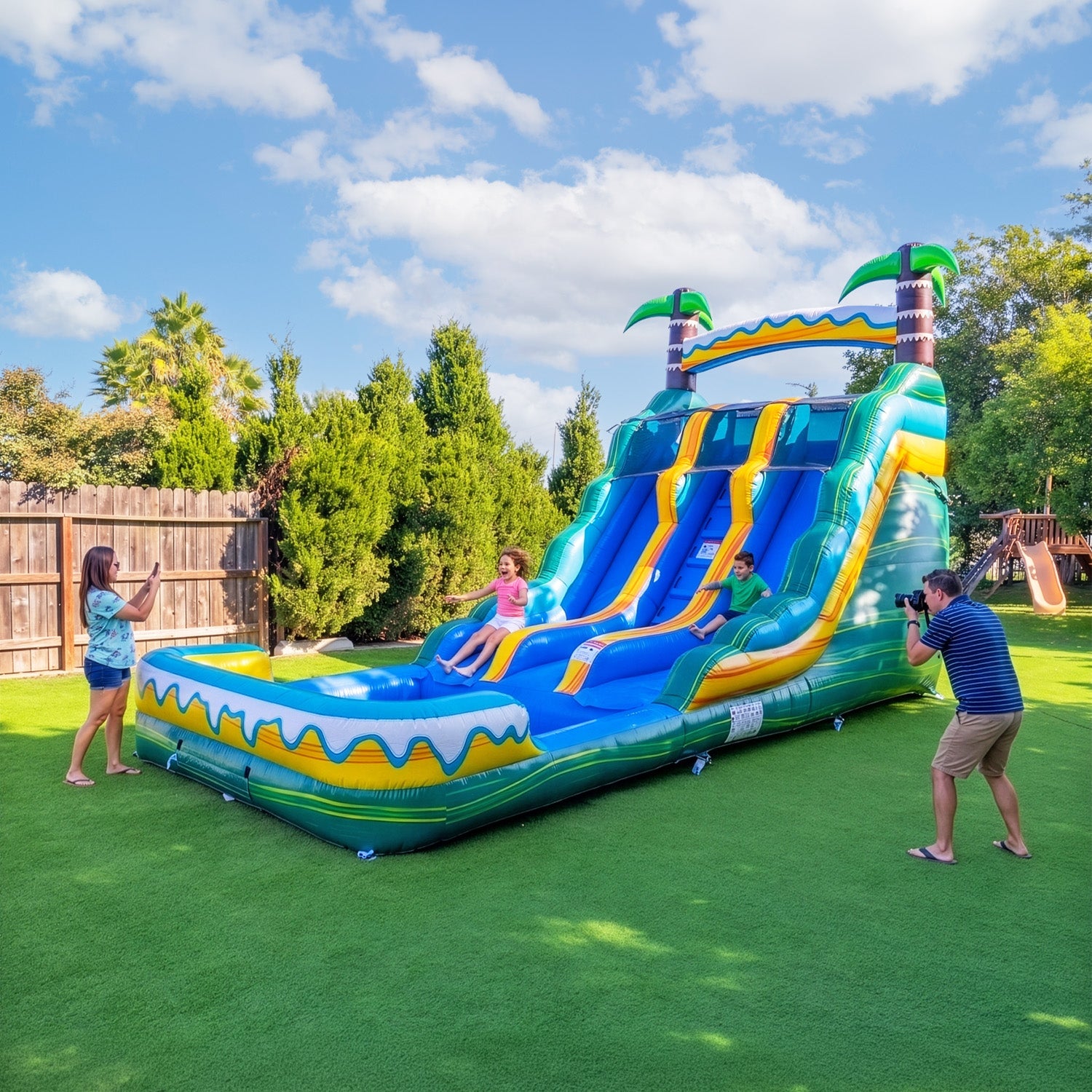 In Stock
Tropical Breeze 15' Dual Lane Water Slide
Two lanes, one winner — the racing slide that ends every argument
NEW! 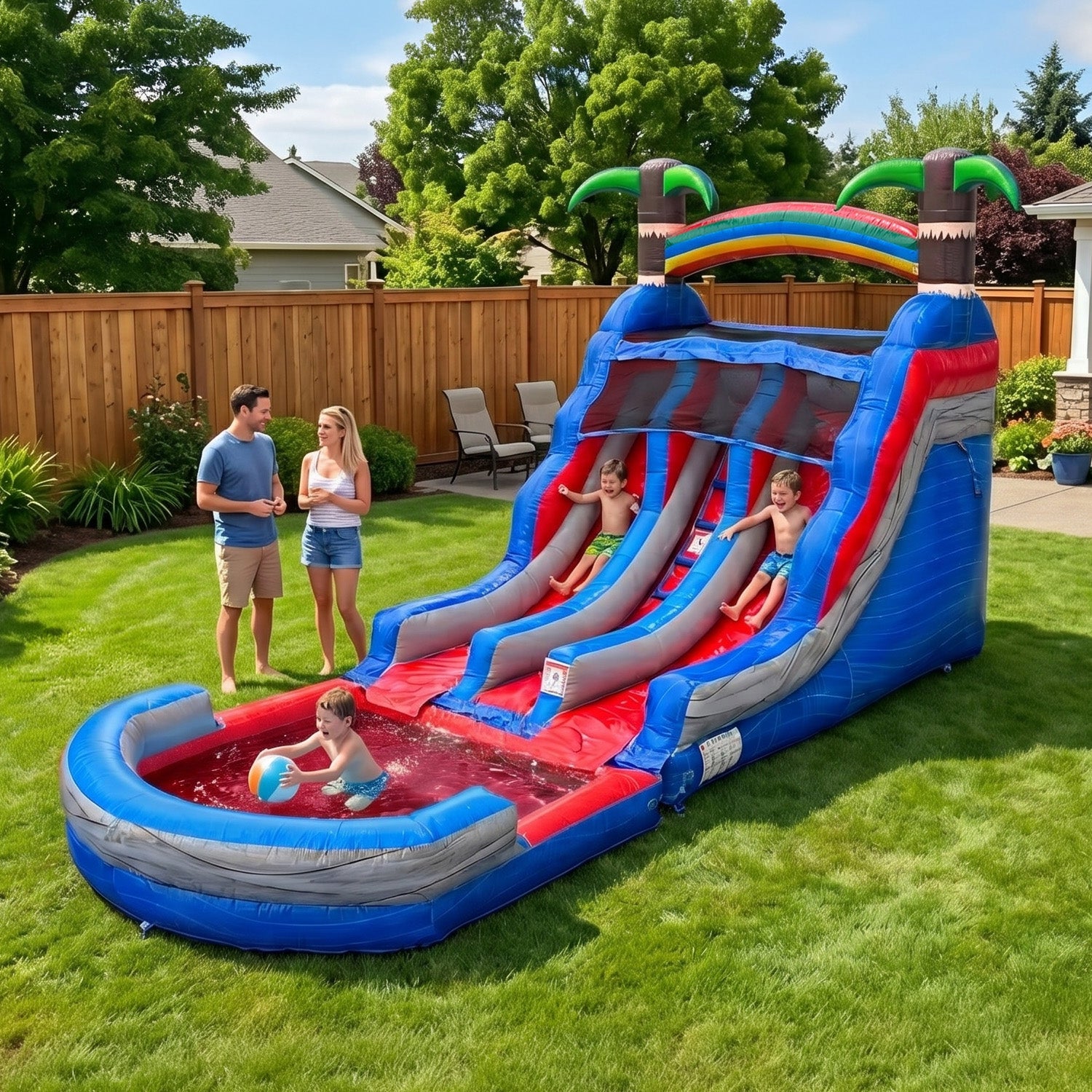 In Stock
Tropic Tide Double Racer 13' Dual Lane Slide with Detachable Pool
Racing lanes for younger riders — dual lane without the height
About the author
The WaterSlides4Kids Team
We sell commercial-grade inflatable water slides, which means we spend a lot of time answering the same questions about vinyl weight, blower sizing, yard measurements, and what actually breaks first. These guides are those answers, written down.
More about usKeep reading
More Guides
- Do You Need a Permit for an Inflatable Water Slide? US State-by-State OverviewWhere permits typically apply, how private backyard use usually differs from commercial operation, and how to check your own jurisdiction properly.
- How to Clean, Dry, and Store an Inflatable Water Slide So It Lasts 10 YearsTwenty minutes of drying is the difference between three seasons and ten. The full end-of-day routine, plus mildew rescue and off-season storage.
- Attached Pool vs. Detachable Pool Water Slides: Pros, Cons, and CleanupOne gives you two products from one purchase. The other removes the joint that fails first. How to choose, and what each means for setup and cleanup.