

Setup & Safety
Inflatable Water Slide Safety: Setup & Supervision Checklist
Site selection, anchoring, wind limits, rider rules and supervision ratios — the checklist to run before anyone climbs, and the conditions that mean shutting down.
By The WaterSlides4Kids Team · · Updated · 10 min read
Most inflatable water slide incidents are not freak accidents. They cluster around a small number of causes, and the two biggest — wind and inadequate anchoring — are almost entirely preventable with decisions made before anyone climbs anything.
This is the checklist we would want a friend to run. It is deliberately specific, and it defers to your unit's own documentation wherever the two might differ.
This is general guidance, not a substitute for your manufacturer's instructions. The documentation in your carton governs — particularly the wind limit, rider weight limit, capacity and age range. Read it before the first setup, not after a problem.
Before you buy: the site survey
Two things disqualify more sites than anything else, and both are easier to check before you order than after.
Overhead clearance. Stand where the slide will actually go, not on the patio, and look straight up. Mature tree canopy, gutters, floodlights, and the overhead service drop from the street all occupy the airspace a slide needs. A unit that rubs a branch each time it shifts in the wind wears through the vinyl long before the seams give out — and a slide near a power line is a category of risk not worth engaging with at all.
Level ground. A slope you cannot see by eye will pool water at one end of the landing basin and make one lane of a racer measurably faster than the other. Check with a spirit level.
Then look at the surface: no sharp stones, sprinkler heads, tree stumps, exposed roots or buried irrigation. Clear a wide margin around the whole footprint of anything hard — fences, patio furniture, garden edging, the barbecue.
Setup checklist
Run this every time, not just the first time.
- Lay a ground tarp. It protects the base from abrasion, keeps the underside clean, and speeds up drying later.
- Unroll and orient. Position the drain plug facing downhill so the basin empties itself later.
- Attach the blower tube. Pull it tight over the outlet and strap it. Site the blower clear of the splash zone and out of any standing water.
- Check deflation zips are closed. The most common cause of a soft-feeling slide.
- Power up on a GFCI-protected outlet. Two blowers require two separate circuits — not two outlets on the same circuit.
- Anchor every point. Stakes driven at an angle away from the unit on grass; sandbags or ballast on hard surfaces. Every anchor point, not the corners you can reach easily.
- Walk the perimeter. Confirm the tethers are taut and nothing is rubbing.
- Check firmness. It should feel solid underfoot, not spongy.
- Run the water at low pressure. You want a film on the lane and a few inches in the basin, not a torrent.
- Do one adult test descent before any child goes down, on every new setup.
Anchoring is not optional and it is not weather-dependent. An unanchored inflatable is a sail. A moderate gust under an untethered unit will move it, with children inside. There is no version of "we're only using it for an hour" that makes this acceptable.
Wind: the rule that matters most
Wind is the leading cause of serious inflatable incidents, and the failure mode is exactly what it sounds like.
Manufacturers commonly specify shutting down somewhere in the 15–25 mph range. Your unit's documentation gives your number and it governs.
The practical discipline is this: deflate before the gust arrives, not after. Weather does not announce itself politely, and the moment it becomes obvious that conditions have turned is already late. Check a forecast before setup. If gusts are forecast near your limit, do not set up at all — a cancelled afternoon is a considerably better outcome than the alternative.
Signs to act on immediately: the structure visibly rocking or lifting at an edge, tethers going slack then snapping taut, or debris starting to move across the yard.
Shut down for: wind above your stated limit, any lightning within earshot, and heavy rain (which makes surfaces slick beyond what the design assumes).
When you shut down: get everyone off first, then switch the blower off, then keep the unit anchored while it deflates. Do not unstake a partly-inflated slide.
Supervision
At least one adult watching continuously, positioned so they can see both the platform at the top and the landing pool. Not a parent who is also cooking. Not an older sibling. An adult whose job for that period is watching the slide.
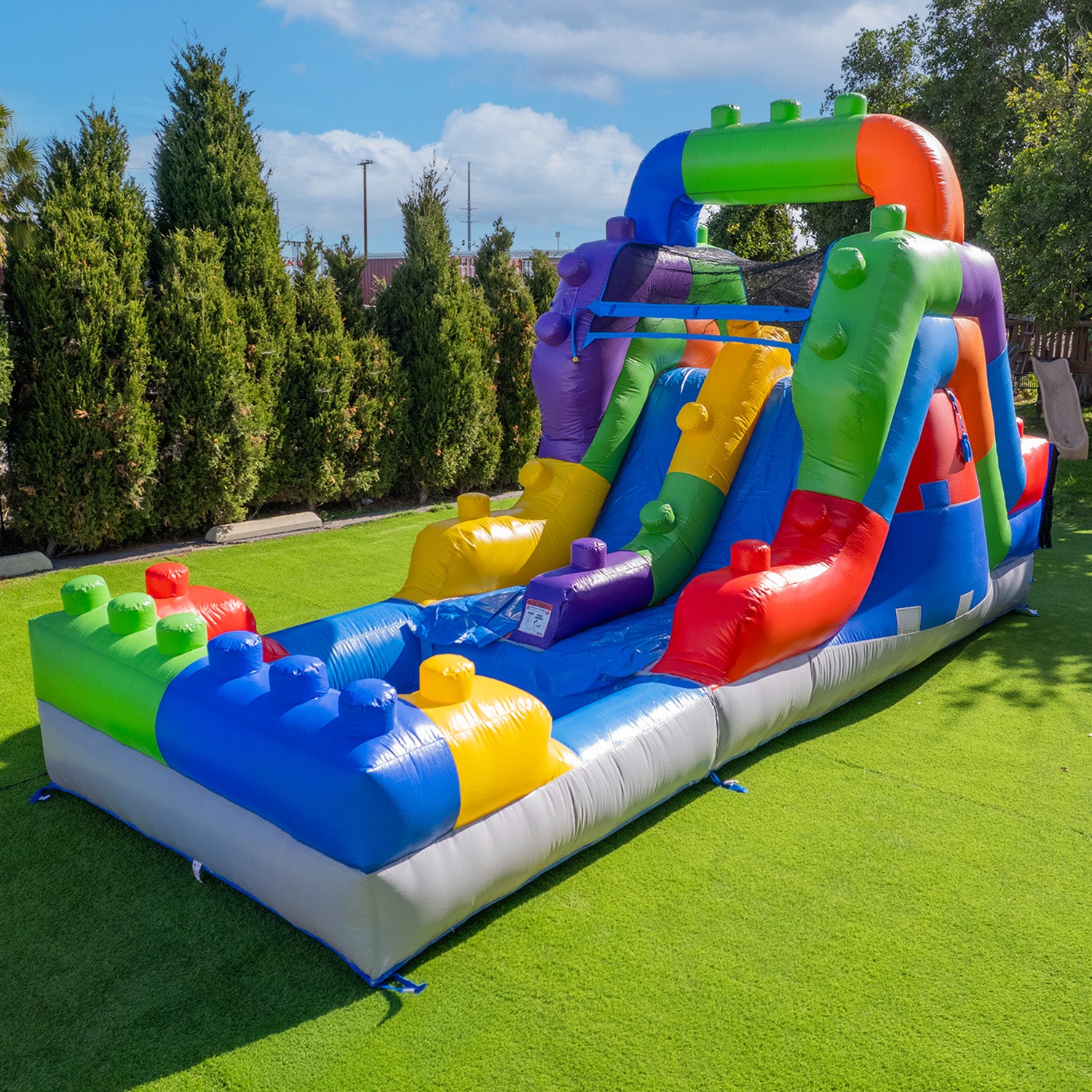
A combo unit needs two adults. A bounce chamber and a slide are separate zones and one person cannot properly watch both at a busy party. Units like the 12' Block Party Backload help by putting the climbing wall at the rear so climbers and riders never cross paths, but circulation design reduces the supervision load rather than removing it.
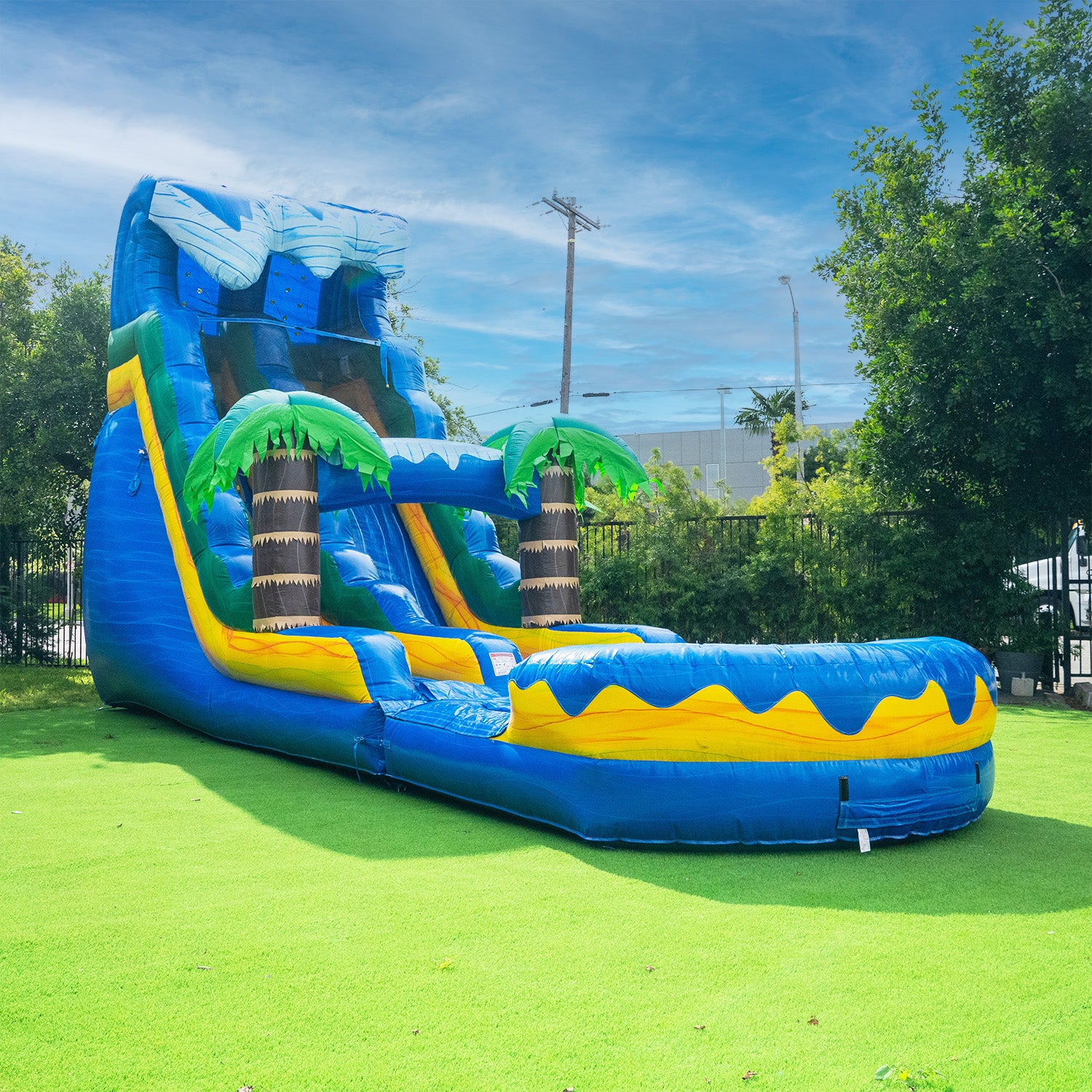
A deep pool raises the requirement rather than lowering it. Taller units such as the 19' Surf Beach use deep pools precisely because riders arrive fast, and a pool of any depth should never be unwatched even briefly.
Rider rules
Agree these out loud with the children before the first descent. Kids follow rules they have heard stated; they do not follow rules that were only in an adult's head.
- One rider per lane at a time. A second rider removes the room the first needs to decelerate.
- Feet first, sitting up, facing forward. No head-first, no standing, no going down backwards.
- Wait for the previous rider to clear the pool before the next one starts.
- Climb up the wall, come down the lane. Never walk up a lane.
- No jumping from the platform.
- Nothing hard, sharp or loose: no shoes, glasses, jewellery, buckles, keys, phones, or toys.
- No pushing at the top. The platform is the highest-consequence place on the unit.
- Group riders by size. A twelve-year-old and a four-year-old in adjacent lanes is a collision waiting for a reason.
- Observe the weight limit and age range stated in your documentation.
The specifications caveat
Every specification currently shown on our product pages — footprint, rider capacity, weight limit, age range, blower requirement — is labelled as an example representative of that class of slide, pending supplier confirmation. They are there to help you plan, not to be relied on as final.
The figures that ship with your unit are the ones that govern, and the weight limit and age range in particular are safety limits rather than suggestions. Read them.
During the session
- Keep the blower running the whole time. These are constant-airflow units.
- Keep water flowing at low pressure; a dry lane in hot sun both slows riders and gets uncomfortably warm.
- Re-check anchor points every hour or so, and after any period of stronger wind.
- Watch for tiredness. Most bumps happen late in a session, when kids are worn out and stop following the rules they agreed to.
- Keep food, drinks and anything glass well away.
- Sun protection matters — children on a slide for three hours are in direct sun for three hours.
Shutting down
- Everyone off, and confirm it. Look inside a bounce chamber rather than calling into it.
- Turn off the water.
- Turn off the blower and let the unit settle.
- Pull the drain plug and let the basin empty.
- Leave the anchors in until it is genuinely flat.
The habit that protects the equipment
Before it goes in the bag, the slide must be completely dry. Not mostly dry. Not dry by tomorrow.
Re-inflate it, hose off grass and dirt, and let it run in moving air for around twenty minutes. Damp vinyl grows mildew that etches the PVC coating, stains permanently, smells, and voids most warranties — it is the leading cause of premature failure in this category, well ahead of punctures and UV. The full cleaning and storage routine is worth reading once and then following forever.
While it is inflated for drying, walk the seams and the lane surface looking for wear. Catching a small puncture and patching it on a clean dry surface takes five minutes; ignoring it turns it into a tear.
Commercial operation
If you rent units out, everything above applies plus:
- Liability insurance written for inflatable amusement rental. A generic small-business policy typically will not respond to an inflatable claim.
- Written safety rules handed to the customer at every delivery, and walked through rather than left on a table.
- Staff training on setup, anchoring, wind limits and shutdown.
- A documented pre-delivery inspection of seams, anchor points and blowers.
- State registration and inspection requirements, which vary considerably — verify with your own state agency. Our permit overview explains where to look.
More on the operational side in the rental business guide.
The five that matter most
If you remember nothing else:
- Anchor every point, every time. No exceptions.
- Know your wind limit and deflate early.
- One adult watching continuously; two on a combo.
- One rider per lane, feet first, sitting up.
- Dry it completely before it goes in the bag.
Choosing a slide for a younger group? Compact units like the 15' Ocean Shark are easier to site, easier to supervise and run on a single blower circuit. Browse all 26 slides or read the buyer's guide before you decide on height.
Quick answers
Frequently asked
What wind speed is too high for an inflatable water slide?
Manufacturers commonly specify shutting down somewhere around 15–25 mph, and your unit’s own documentation governs. Deflate and secure before the gust arrives rather than after — wind is the leading cause of serious inflatable incidents.
How many adults should supervise an inflatable water slide?
At least one adult watching continuously, positioned where they can see both the platform and the pool. A combo with a separate bounce chamber needs two, because one person cannot properly watch both zones.
Do inflatable water slides need to be anchored?
Always. Stakes on grass, ballast or sandbags on hard surfaces, at every anchor point. An unanchored inflatable is a sail.
Mentioned in this guide
Slides Worth a Look
- In Stock
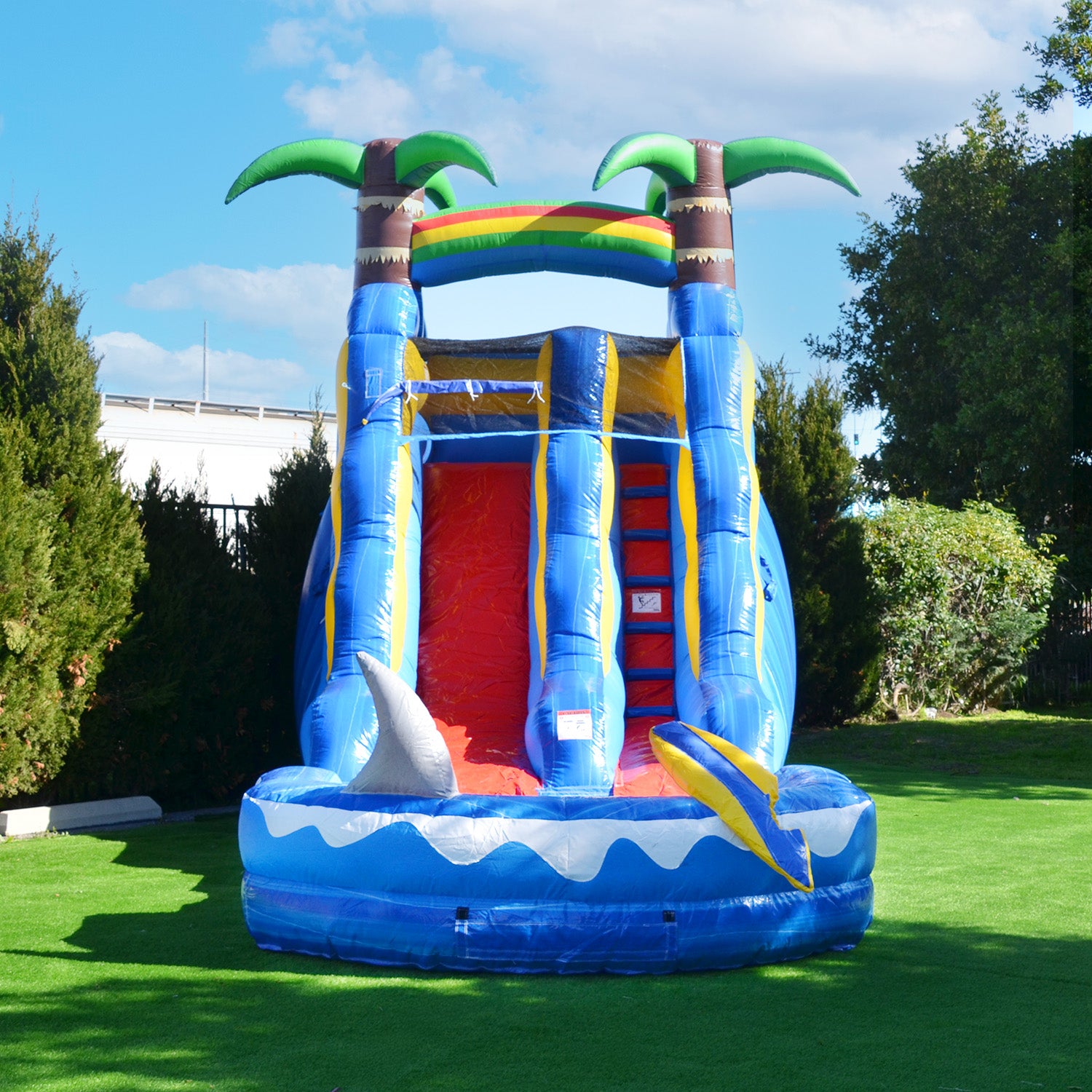
15' Ocean Shark Water Slide with Detachable Pool
A shark with its mouth open at the top of the ladder. Kids lose their minds.
 In Stock
Block Party 12' Dual Lane Backload Water Slide with Attached Pool
Backload climbing wall — riders go up the back, so nobody crosses the lanes
 Out of Stock
Surf Beach 19' Single Lane Water Slide with Detachable Deep Pool
Maximum height, one wide lane, and a deep pool that detaches
Call for Availability
View details
About the author
The WaterSlides4Kids Team
We sell commercial-grade inflatable water slides, which means we spend a lot of time answering the same questions about vinyl weight, blower sizing, yard measurements, and what actually breaks first. These guides are those answers, written down.
More about usKeep reading
More Guides
- Do You Need a Permit for an Inflatable Water Slide? US State-by-State OverviewWhere permits typically apply, how private backyard use usually differs from commercial operation, and how to check your own jurisdiction properly.
- How to Clean, Dry, and Store an Inflatable Water Slide So It Lasts 10 YearsTwenty minutes of drying is the difference between three seasons and ten. The full end-of-day routine, plus mildew rescue and off-season storage.
- Attached Pool vs. Detachable Pool Water Slides: Pros, Cons, and CleanupOne gives you two products from one purchase. The other removes the joint that fails first. How to choose, and what each means for setup and cleanup.