

Buying Guides
How Much Does an Inflatable Water Slide Cost?
Prices by height and configuration, what drives them, and the ongoing costs — water, electricity, storage, repairs — that never appear on a product page.
By The WaterSlides4Kids Team · · Updated · 9 min read
Inflatable water slides sell for anywhere between about $300 and $6,000, which is an unhelpfully wide range if you are trying to work out what a reasonable number looks like.
The range is wide because it spans two different product categories and four different size classes. Once you separate those out, pricing in this market is actually quite predictable.
What drives the price
Four things, in roughly this order of impact:
- Material grade. Consumer 6–9oz PVC versus commercial 15oz PVC. This is the biggest single divide and the one most listings are vaguest about.
- Size. More vinyl, more seams, more hand-sewing labour. A 19-foot unit uses more than twice the material of a 13-footer.
- Lane count and pool type. A second lane adds material and complexity. A detachable deep pool adds a precision seam that has to survive repeated fitting.
- Blowers. Larger units need two rather than one, and the blowers are a real cost line, not an accessory.
Notably absent: theming. A dinosaur costs essentially the same to manufacture as a plain colourway. Character units sometimes carry a small premium for extra sculpted appliqués, but if a slide is priced $800 above a structurally identical one purely because of the artwork, you are paying for the artwork.
2026 price bands, commercial grade
These are the bands we actually sell in. Everything here is 15oz commercial PVC with a blower included.
| Class | Typical price | What you get | | --- | --- | --- | | 12–13 ft single lane | $700 – $1,300 | Compact, one blower, attached pool, ages 3–9 | | 13 ft dual lane | $1,300 – $1,700 | Racing on a small frame, detachable pool | | 15–16 ft single lane | $1,350 – $1,450 | The volume bracket, widest choice | | 15–17 ft dual lane | $1,800 – $2,900 | Two lanes, often a detachable pool | | Wet/dry combos | $1,950 – $2,750 | Bounce house, climb, slide and pool in one | | 19 ft flagships | $2,400 – $3,700 | Deep pools, two blower circuits, event scale | | Obstacle courses | $3,200 + | 45 ft, multi-blower, two-person setup |
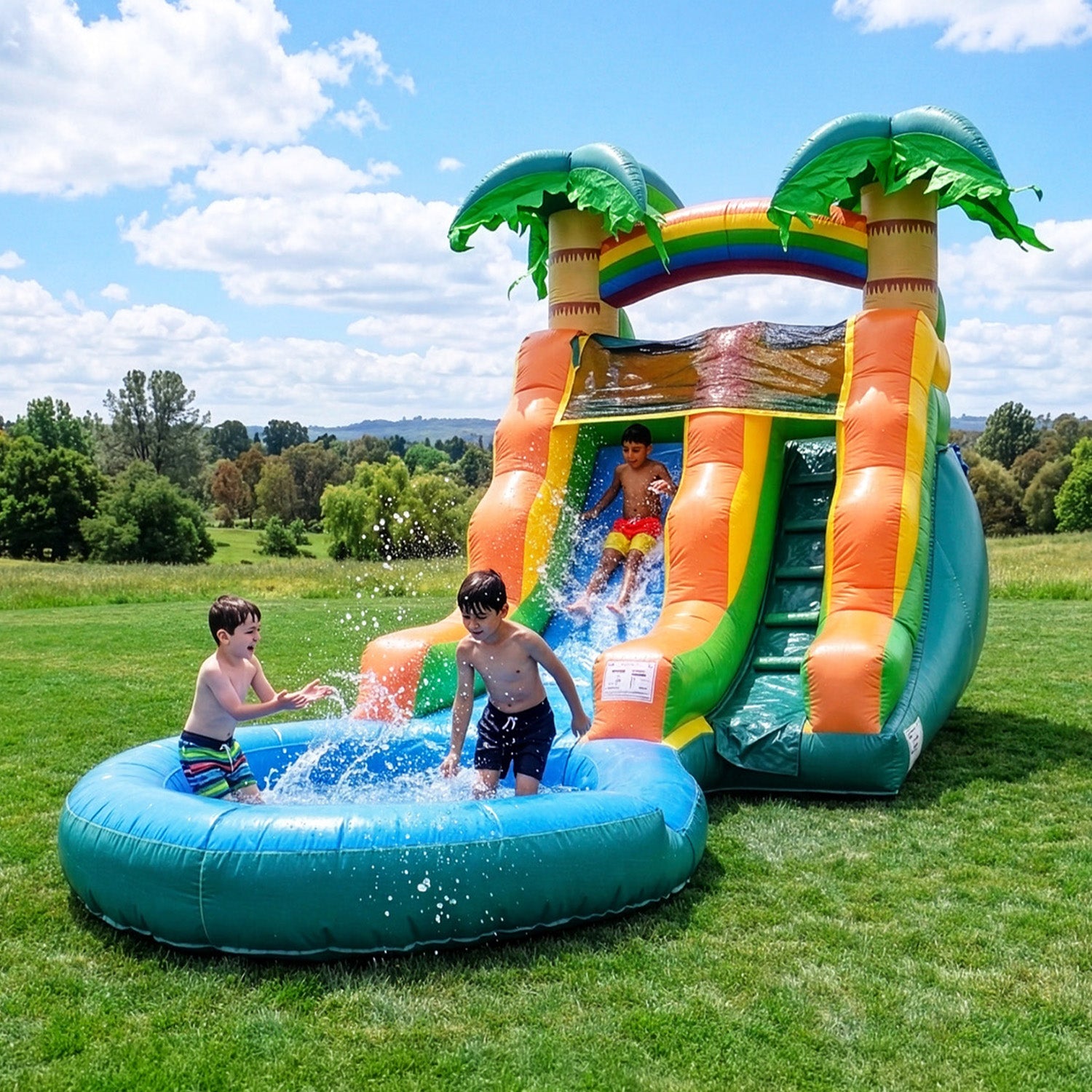
The single cheapest genuine entry point into commercial construction sits around $700 — the 13' Summer Breeze is at that number, and it is the same vinyl and seam spec as slides costing three times as much. What you give up for the price is height, a second lane and a detachable pool, not material quality.
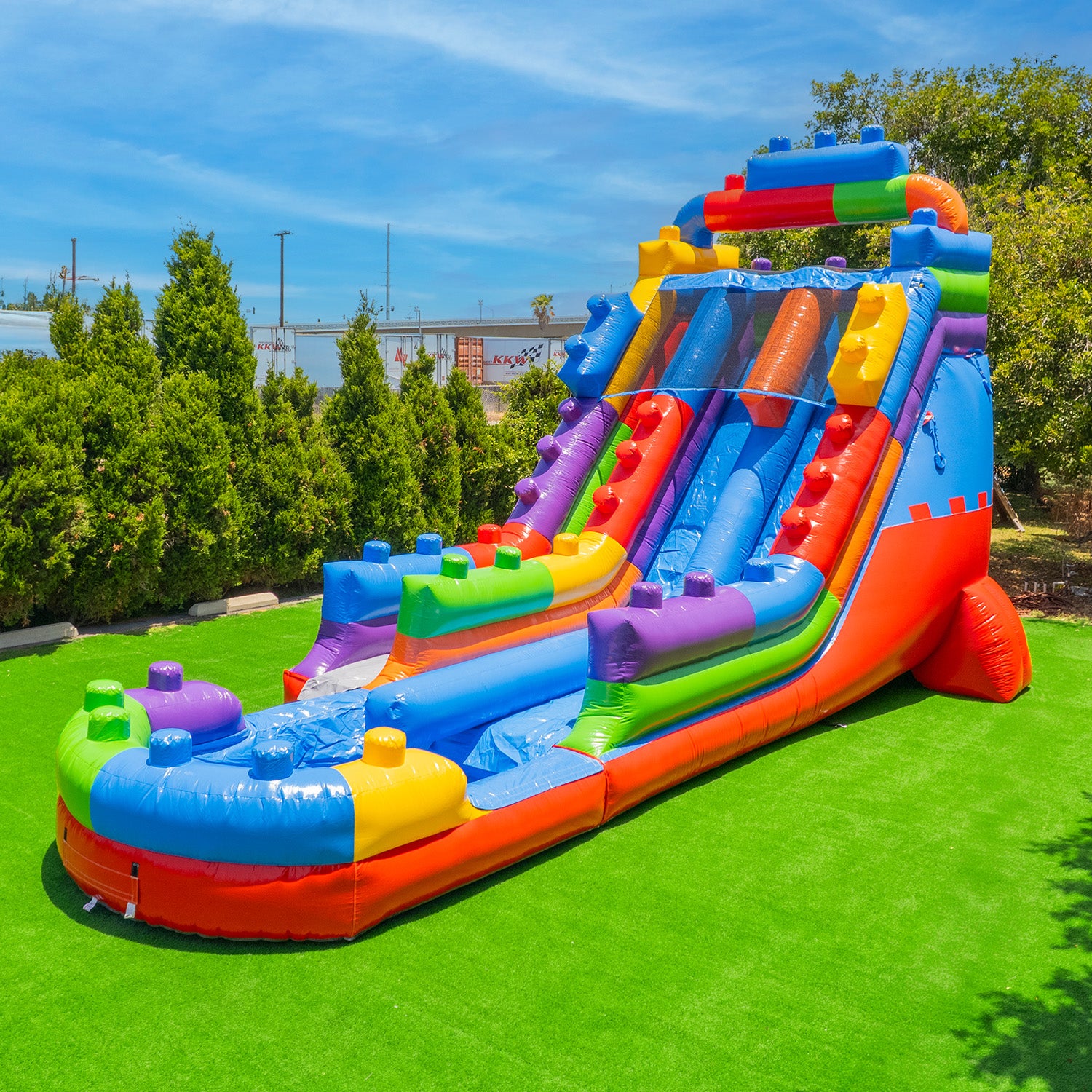
At the other end, the 19' Block Party dual lane sits north of $3,000 because it is genuinely a different class of object: twice the vinyl, a deep pool, two blowers, and 470lb of shipping weight.
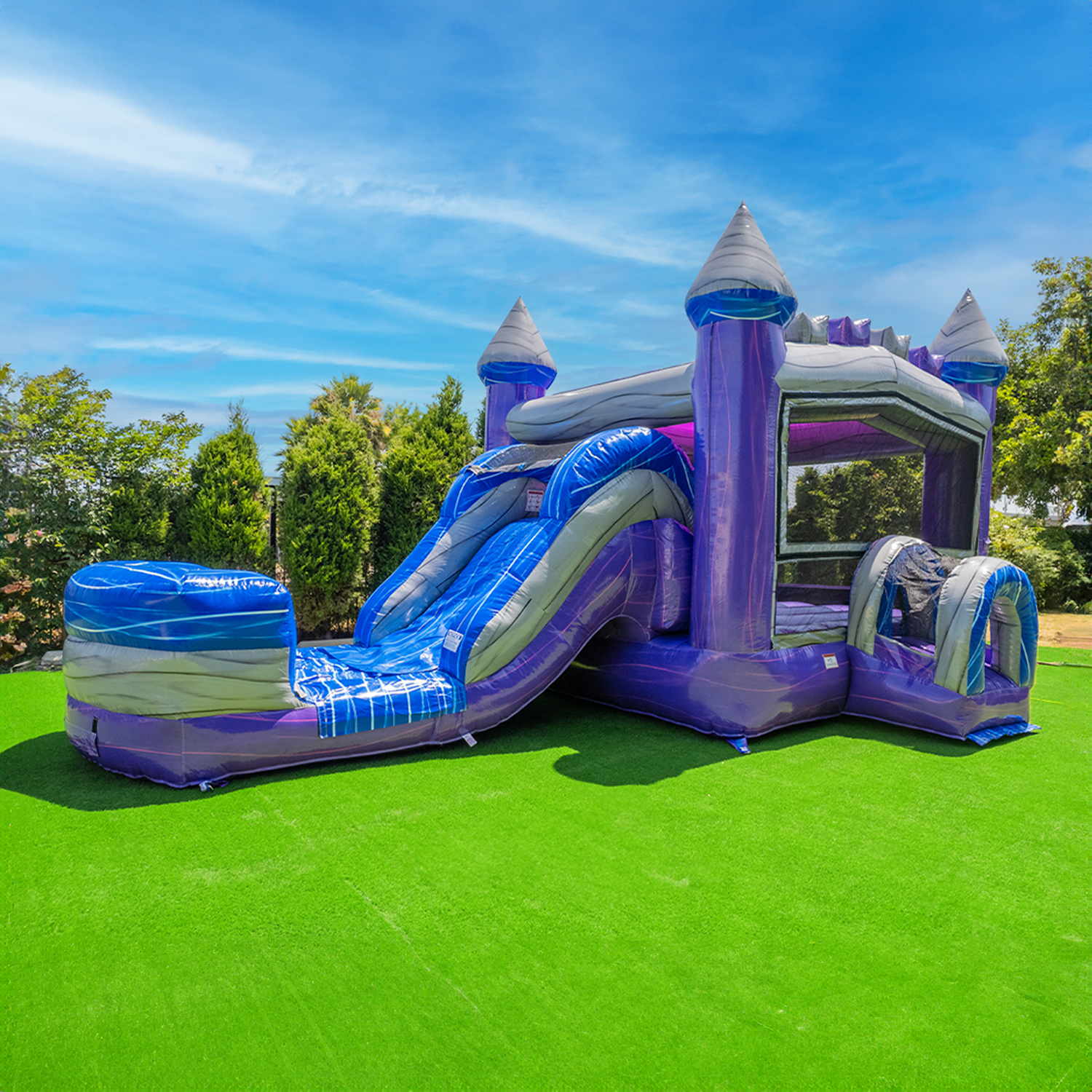
Best value in absolute terms is usually a combo. The Purplish Castle wet/dry combo is under $2,000 for a bounce chamber, a climbing wall, a slide lane and a splash pool — four attractions on one footprint, which is why cost-per-use on combos tends to beat everything else.
Why MSRP figures look so strange
You will notice discounts across this category that look implausible — 50% off, 60% off, permanently. That is not a manufactured markdown so much as an artefact of how the industry sets list prices.
Manufacturer suggested pricing in inflatables is set high and is largely notional; almost nobody transacts at it. The useful comparison is not the discount percentage but the actual price against other actual prices for the same configuration. A slide at $1,367 is a good deal or a bad one depending on what comparable 16-foot single-lane units with attached pools cost, not on what its MSRP claims.
Treat a large discount as neutral information. Compare selling prices.
The costs that are not on the product page
The purchase price is most of what you will spend, but not all of it.
Electricity. A 1.5 HP blower draws roughly 1.1kW. Running four hours at the US average residential rate of around 16 cents per kWh works out to about 70 cents per session. Two blowers, double it. This is genuinely trivial and should not factor into your decision.
Water. A slide needs a film of water down the lane and a few inches in the basin, not a torrent. Most households see a modest bump on one bill, not a shock. If you are on metered water and using it heavily, expect single-digit dollars per session, not tens.
A ground tarp. $30–60 and the best money you will spend. It stops abrasion from underneath, keeps the base clean, and makes drying and packing faster.
Storage space. Free if you have it, genuinely annoying if you do not. A 15-foot slide packs to roughly the volume of a large suitcase; a 19-footer or a combo is bigger and heavier than one person wants to move alone.
Replacement blower. Eventually. Budget $150–250 when the time comes, and match the CFM rating rather than the horsepower number — the blower sizing guide explains why those are not the same thing.
Repairs. Patch kits come in the box. A puncture patched promptly on a clean dry surface costs nothing and holds for years.
The cost nobody budgets for
Replacing a slide you failed to dry.
Mildew from damp storage is the leading cause of premature failure in this category — ahead of punctures, seam wear and UV damage combined. It etches the PVC coating, stains permanently, smells, and voids most warranties. The fix costs twenty minutes per session and nothing in money; the failure costs the entire purchase price again. The cleaning and storage routine is the highest-return reading in this whole blog.
Buy versus rent
Renting a comparable slide typically runs $200–400 per day depending on your market and the size of the unit.
That means a $700 commercial 13-footer pays for itself in two to three rental days. A $1,367 sixteen-footer takes four or five. If you host more than a couple of gatherings a summer, ownership wins quickly — and unlike a rental, it is available on a hot Tuesday in July when nobody planned anything.
Renting still makes sense for a genuine one-off, for a unit far larger than you would ever store, or if you have nowhere to keep it.
Buying to rent out
Flip the maths and the numbers get interesting. At $250 per booking, a $1,800 dual-lane unit covers its purchase price in roughly seven or eight bookings. In a busy market, that is achievable inside a first season.
The purchase price is not the whole story for a business, though — liability insurance, a vehicle rated for 300–700lb, cleaning time between bookings, and off-season storage all belong in the model. We build it out with realistic rather than optimistic numbers in the rental business guide, and payment options are covered on the financing page.
Where to spend and where not to
Worth paying for:
- 15oz commercial vinyl. Non-negotiable if the slide will see regular use. The full comparison shows why it is cheaper over five years.
- A second lane, if you have two or three kids close in age. It buys peace, not just throughput.
- A detachable pool, if dry-season use is worth two or three extra months of the year to you.
Not worth paying for:
- Height beyond what your riders will use. The most expensive mistake in this category is a nineteen-footer bought for a six-year-old who rides it four times.
- Theming, as a price premium. Pay for the artwork you like at a fair price; do not pay a large premium for it.
- Expedited shipping, usually. It prioritises dispatch but does not change carrier transit time, so it typically saves a day or two.
A realistic budget
For most families the honest answer is $700 to $1,400, and where you land inside that range is set by the age of your children rather than by your budget. Younger kids genuinely get more use out of a shorter slide, so spending less is frequently the better outcome rather than a compromise.
Two or three children close in age push you to a dual-lane unit at $1,300–1,900. Wanting a bounce house as well pushes you to a combo at $2,000–2,700 — and a combo is usually cheaper than buying both separately.
Above $3,000 you are into event equipment. Those units are excellent and they need clearance, power and a vehicle most households do not have.
Browse all 26 slides sorted by price, or start with the buyer's guide if you have not settled on a size.
Quick answers
Frequently asked
How much does a commercial inflatable water slide cost?
Roughly $700 for a compact 13ft commercial unit up to about $3,700 for a 19ft dual-lane flagship. Combos sit in between, from about $2,000.
Why are inflatable water slides so expensive?
Material and labour. A commercial slide is 15oz PVC with quadruple-stitched seams, and the sewing is done by hand. Bigger units use more of both, plus more blowers.
How much does it cost to run an inflatable water slide?
A 1.5 HP blower running four hours costs roughly a dollar or two in electricity in most of the US, plus your water. The real ongoing cost is replacing a slide you failed to dry properly.
Mentioned in this guide
Slides Worth a Look
- In Stock
Purplish Castle Wet & Dry Slide Combo with Attached Splash Pool
The cheapest way into a full combo — castle turrets, bounce house, slide, pool
 In StockBest Value
13' Summer Breeze Water Slide with Pool
Commercial vinyl at a big-box price — the entry point that is not a compromise
 In Stock
Block Party 19' Dual Lane Water Slide with Attached Deep Pool
Nineteen feet, two lanes, and a deep pool — the flagship
About the author
The WaterSlides4Kids Team
We sell commercial-grade inflatable water slides, which means we spend a lot of time answering the same questions about vinyl weight, blower sizing, yard measurements, and what actually breaks first. These guides are those answers, written down.
More about usKeep reading
More Guides
- Do You Need a Permit for an Inflatable Water Slide? US State-by-State OverviewWhere permits typically apply, how private backyard use usually differs from commercial operation, and how to check your own jurisdiction properly.
- How to Clean, Dry, and Store an Inflatable Water Slide So It Lasts 10 YearsTwenty minutes of drying is the difference between three seasons and ten. The full end-of-day routine, plus mildew rescue and off-season storage.
- Attached Pool vs. Detachable Pool Water Slides: Pros, Cons, and CleanupOne gives you two products from one purchase. The other removes the joint that fails first. How to choose, and what each means for setup and cleanup.